
Introduction
Organizations exploring digital credentialing solutions often face confusion when comparing MixCertificate vs Open Badges. This confusion arises because certificates and credential standards are frequently discussed together, even though they represent fundamentally different approaches to digital credentials.
As digital credential adoption accelerates across training providers, educational institutions, and professional organizations, decision-makers must distinguish between operational certificate platforms and technical credential standards. Understanding the MixCertificate vs Open Badges distinction is essential for selecting solutions aligned with verification needs, technical capacity, implementation timelines, and long-term credential strategy.
This comparison explains what MixCertificate and Open Badges represent, how they differ in purpose and implementation, and when certificates or badge standards are the better choice. It provides practical guidance for organizations seeking clarity rather than hype when navigating modern digital credentials.
Certificates vs Credential Standards Explained
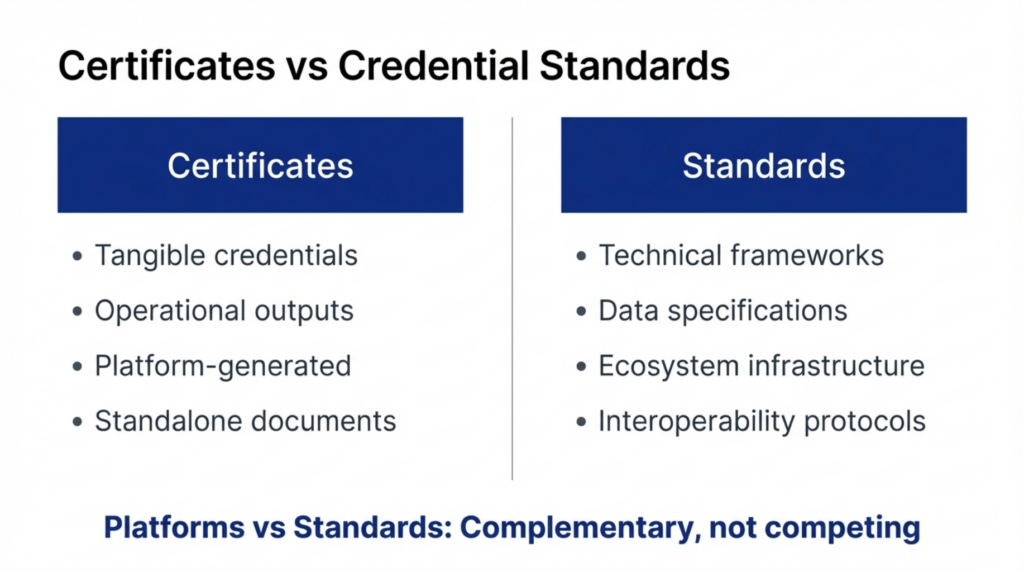
At the core of MixCertificate vs Open Badges lies a crucial distinction between deliverables and frameworks.
Certificates are tangible credentials issued to confirm completion, participation, or achievement. Platforms like MixCertificate generate, distribute, and verify certificates as operational outputs. Certificates function as standalone proof of accomplishment issued by trusted organizations.
Credential standards, on the other hand, define how credential data is structured and verified across systems. Open Badges is not a certificate platform but an open technical standard specifying metadata formats, verification rules, and interoperability requirements.
This difference matters because organizations often compare platforms with standards, even though standards require platforms for implementation. Certificates can exist without standards, while standards cannot function without issuing systems.
What Is MixCertificate?
MixCertificate is a certificate platform built for organizations that need fast, reliable, and automated certificate operations.
In the MixCertificate vs Open Badges discussion, MixCertificate represents the platform approach. It enables organizations to design certificates, generate them in bulk, automate issuance workflows, and provide verification through QR codes and unique URLs.
Common MixCertificate use cases include:
-
Corporate training completion certificates
-
Event participation certificates
-
Compliance and regulatory documentation
-
Online course completion credentials
-
Continuing education tracking
Key strengths include automation, bulk processing, verification infrastructure, LMS and event integrations, and centralized record management. MixCertificate treats certificates as operational necessities that must be accurate, scalable, and easy to manage.
What Are Open Badges?
Open Badges is an open credentialing standard rather than a service or platform.
In the MixCertificate vs Open Badges comparison, Open Badges defines how credential data is embedded, shared, and verified across ecosystems. Badge files contain structured metadata such as issuer identity, skill criteria, evidence links, issue dates, and verification endpoints.
Open Badges enable credential portability. Learners can aggregate badges from multiple issuers and present them across platforms without being locked into a single provider.
The Open Badges ecosystem involves three roles:
-
Issuers who award credentials
-
Earners who receive and share badges
-
Verifiers who validate authenticity
This approach supports skill-based credentialing and cross-institution recognition but requires standards-compliant platforms or custom development.
MixCertificate vs Open Badges: Key Differences
| Area | MixCertificate | Open Badges |
|---|---|---|
| Nature | Certificate platform | Credential standard |
| Primary Output | Certificates | Metadata-rich badges |
| Verification | Platform-hosted links and QR codes | Decentralized metadata verification |
| Implementation | Immediate platform use | Requires standards-compliant systems |
| Technical Skill | Low | Medium to high |
| Automation | Built-in bulk workflows | Depends on platform |
| Portability | Platform dependent | Platform independent |
| Best For | Operational efficiency | Ecosystem interoperability |
This table highlights why MixCertificate vs Open Badges is not a winner-takes-all comparison but a choice between priorities.
When Certificates Make More Sense
Certificates are ideal when organizations prioritize speed, simplicity, and operational efficiency.
Training departments, event organizers, and compliance programs benefit from MixCertificate when credentials must be issued quickly, verified easily, and managed without technical complexity. In these scenarios, MixCertificate vs Open Badges favors certificates because implementation time and usability outweigh ecosystem considerations.
Certificates also align well with employer expectations, as PDFs and verification links remain widely understood and trusted.
When Open Badges Are the Better Choice
Open Badges are better suited for credential ecosystems emphasizing portability and long-term value.
Universities, workforce development programs, and multi-issuer skill initiatives benefit from Open Badges when learners need credentials that travel across institutions and platforms. In the MixCertificate vs Open Badges debate, badges win when interoperability and metadata richness matter more than operational speed.
However, this benefit comes with higher implementation effort and ecosystem coordination.
Verification and Trust Models
Verification is a critical difference in MixCertificate vs Open Badges.
MixCertificate uses centralized verification through hosted pages accessed via QR codes or unique URLs. This method is simple and immediately understandable.
Open Badges rely on embedded metadata and cryptographic verification that can be validated independently of the issuing platform. This offers resilience and portability but requires technical familiarity among verifiers.
Both approaches establish trust, but they serve different audiences and expectations.
Ease of Use and Implementation Speed
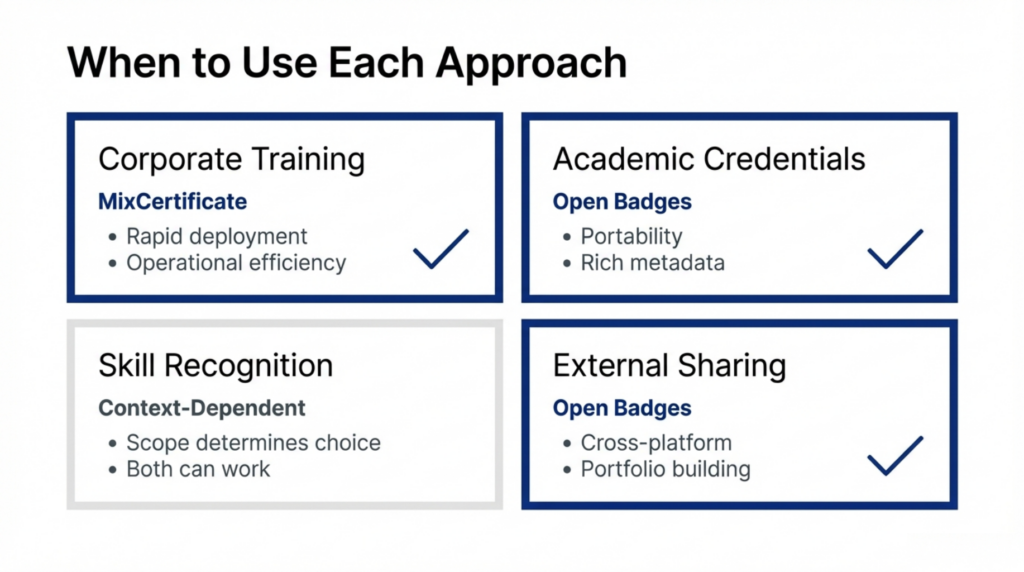
MixCertificate offers rapid deployment. Organizations can issue certificates within hours or days with minimal technical expertise.
Open Badges require selecting compliant platforms, configuring metadata, and integrating with badge ecosystems. Deployment often takes weeks or months.
For teams comparing MixCertificate vs Open Badges, implementation speed is often the deciding factor.
Pricing and Operational Costs
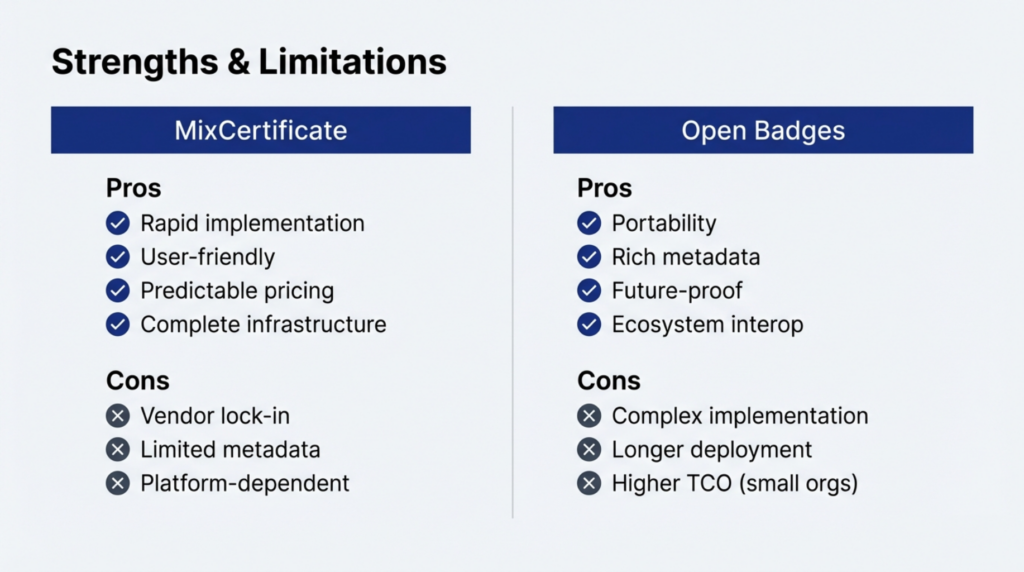
MixCertificate follows a subscription model based on usage and features. Costs are predictable and include infrastructure, support, and verification hosting.
Open Badges may involve platform fees, development costs, and ongoing technical maintenance. Total cost of ownership can be higher for small teams without dedicated technical staff.
Who Should Choose what?
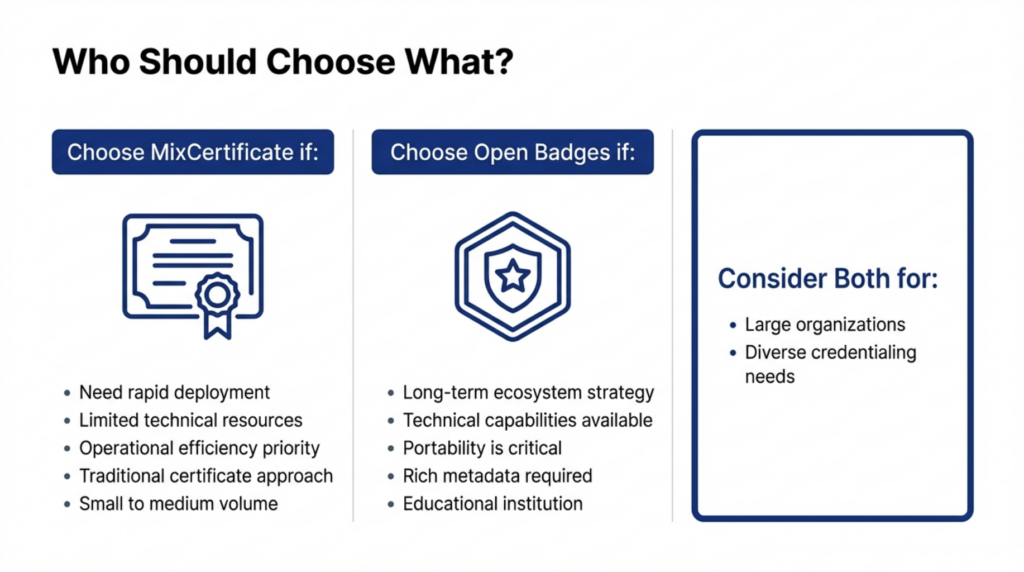
Choose MixCertificate if you need:
-
Fast deployment
-
Automated bulk certificates
-
Simple verification
-
Minimal technical overhead
Choose Open Badges if you need:
-
Credential portability
-
Multi-issuer ecosystems
-
Rich skill metadata
-
Long-term credential strategies
Many organizations use both approaches strategically.
Frequently Asked Questions (FAQs)
What is the difference between MixCertificate and Open Badges?
MixCertificate is a certificate platform providing complete infrastructure for certificate generation, distribution, and verification. Open Badges is a technical standard defining how credential metadata gets structured and verified across platforms and organizations. MixCertificate produces certificates as operational outputs. Open Badges defines credential data format enabling portability. Organizations use MixCertificate directly as a service. Organizations implement Open Badges standards through various platforms or custom systems.
Are Open Badges better than certificates?
Open Badges and certificates serve different purposes rather than one being universally better. Open Badges excel at credential portability, rich metadata, and ecosystem interoperability across multiple organizations and platforms. Traditional certificates from platforms like MixCertificate excel at operational efficiency, rapid deployment, and straightforward verification. Better choice depends on whether organizations prioritize ecosystem participation and credential portability (badges) or operational simplicity and immediate implementation (certificates).
Can Open Badges replace certificates?
Open Badges can replace traditional certificates in contexts valuing credential portability, rich metadata, and ecosystem interoperability. However, many organizations prefer certificate platforms like MixCertificate for operational efficiency, implementation simplicity, and straightforward verification that traditional certificates provide. Rather than complete replacement, Open Badges and certificates often coexist serving different organizational needs and credentialing philosophies within digital credential ecosystems.
Is MixCertificate compatible with badge systems?
MixCertificate focuses on traditional certificate generation and verification rather than Open Badges standard implementation. Organizations requiring both certificate operations and badge-based credentials might use MixCertificate for straightforward certificate needs while employing separate badge platforms for standards-compliant credentials. Some organizations issue both certificates through platforms like MixCertificate and badges through badge-compliant systems, selecting appropriate approaches based on specific credential purposes and recipient needs.
Which is better for training programs?
Training programs typically benefit from certificate platforms like MixCertificate when priorities include rapid deployment, automated bulk generation, straightforward verification, and operational efficiency. Organizations treating training certificates as routine documentation find platforms more practical than implementing Open Badges standards. However, training programs prioritizing credential portability, rich competency metadata, or ecosystem participation with employers and educational institutions might justify Open Badges implementation despite additional complexity.
Conclusion
The MixCertificate vs Open Badges comparison highlights two valid but different approaches to digital credentials. MixCertificate excels at operational certificate management, while Open Badges excel at ecosystem interoperability and credential portability.
Explore MixCertificate Pricing Plans for your Organizations and understanding this distinction prevents mismatched expectations and enables organizations to select credential solutions aligned with real-world needs rather than trends.
