Introduction
Training managers and HR teams frequently compare MixCertificate vs CertifyMe when evaluating certificate automation platforms for organizational training programs, compliance tracking, or event credentialing. This comparison matters because both platforms market themselves as accessible certificate automation solutions designed for teams seeking to eliminate manual certificate creation workflows.
Organizations moving beyond manual document editing or basic design tools need platforms providing automated bulk generation, verification infrastructure, integration capabilities, and scalable workflows supporting program growth. The MixCertificate vs CertifyMe comparison helps decision-makers understand which platform better matches their specific requirements around automation depth, integration flexibility, reporting sophistication, and operational scalability.
Overview: Certificate Automation Platforms
Certificate automation platforms transform manual certificate creation into systematic operational processes eliminating repetitive work and human error.
What certificate automation tools do centers on replacing manual document editing with automated credential generation from recipient data. Platforms enable organizations to design certificate templates once, then automatically generate personalized certificates for hundreds or thousands of recipients through CSV uploads, API integrations, or system connections. Automation eliminates manual text entry, reduces errors, speeds credential delivery, and maintains consistent branding across all certificates.
Why teams adopt them reflects operational pain points from manual processes. Manual certificate creation consumes excessive staff time, introduces frequent errors damaging credibility, creates inconsistent formatting across batches, lacks verification preventing fraud, and provides no centralized record management supporting audits. Automation platforms address these pain points through systematic generation, verification infrastructure, and operational efficiency.
Feature Comparison Table
The MixCertificate vs CertifyMe comparison reveals significant capability differences affecting platform suitability for various organizational requirements.
| Feature | MixCertificate | CertifyMe |
|---|---|---|
| Bulk Certificate Generation | Unlimited scale, advanced processing | Moderate volumes, basic processing |
| Automation Workflows | API triggers, webhooks, conditional logic | CSV uploads, scheduled sends |
| API Access | RESTful API, comprehensive endpoints | Basic API, limited functionality |
| Webhooks | Event-driven automation, flexible triggers | Limited webhook support |
| Integrations | Extensive (LMS, HR, CRM, Zapier) | Moderate (select platforms) |
| Verification Support | QR codes, unique IDs, custom domains | Basic hosted verification pages |
| Reporting & Exports | Detailed analytics, custom reports | Basic issuance tracking |
| Branding Options | Complete customization, white-label | Standard template customization |
| Conditional Logic | Advanced personalization rules | Basic merge fields only |
| Scalability | Enterprise-grade unlimited | Moderate volume constraints |
| User Management | Role-based access, team permissions | Basic user accounts |
| Support | Priority support, dedicated success | Standard email support |
Organizations should evaluate features based on current requirements and anticipated growth rather than accepting basic feature adequacy limiting future operational flexibility.
Automation and Workflow Capabilities
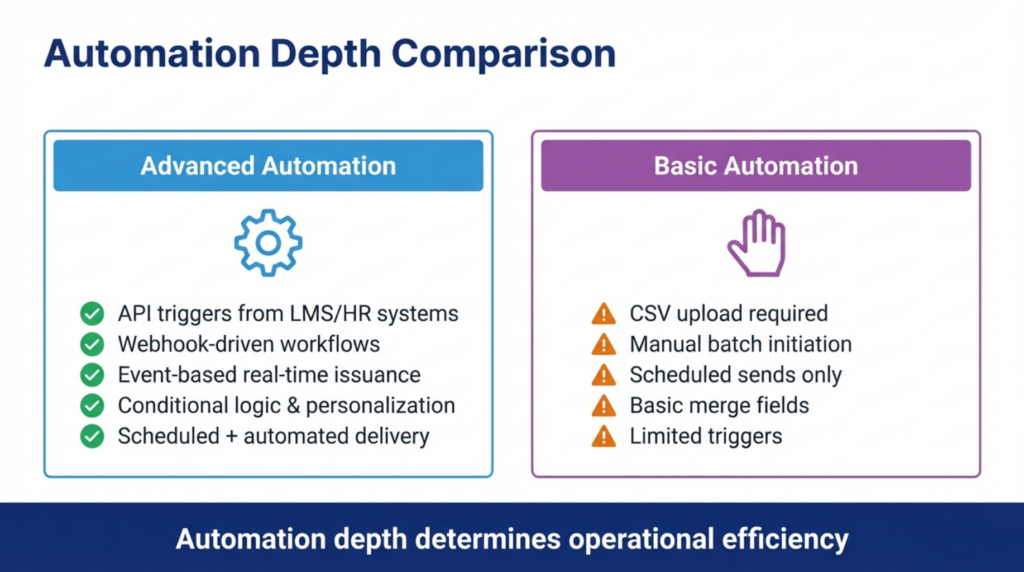
Automation sophistication determines operational efficiency and scalability in the MixCertificate vs CertifyMe evaluation.
Triggers enabling automatic certificate generation differ substantially. MixCertificate supports API triggers from learning management systems issuing certificates when courses complete, HR system triggers generating certificates for training milestones, event platform triggers providing attendee credentials automatically, and custom application triggers integrating certificates into business workflows. CertifyMe lacks comprehensive trigger capabilities requiring manual batch initiation despite scheduling features.
Scheduled vs event-based issuance reflects automation philosophy differences. MixCertificate enables both scheduled issuance for planned certificate delivery and event-based real-time generation when triggering events occur. CertifyMe emphasizes scheduled batch processing requiring pre-planning and manual batch preparation rather than responsive event-driven automation.
Organizations requiring deep automation and extensive integrations should prioritize platforms providing comprehensive API capabilities and trigger flexibility supporting complex workflows.
Bulk Issuance and Scalability
Bulk generation capabilities and scalability determine platform suitability as certificate volumes grow.
How many certificates per batch reveals practical limits. MixCertificate processes unlimited certificates per batch, tested with tens of thousands simultaneously without performance issues. Organizations issue entire cohort certificates in single operations regardless of size. CertifyMe performs adequately for batches under 500-1000 certificates but experiences performance degradation and operational constraints at higher volumes.
Speed and reliability affect operational efficiency. MixCertificate optimized processing generates thousands of certificates within minutes through parallel processing and infrastructure scalability. CertifyMe batch processing requires longer durations for modest volumes with processing times increasing substantially as batch sizes grow.
Error handling determines operational resilience. MixCertificate validates data before generation, provides detailed error reports identifying specific issues, supports partial batch processing continuing despite individual errors, and enables error correction without regenerating entire batches. CertifyMe basic error handling may fail entire batches for individual errors requiring complete reprocessing.
Large lists vs small lists affects usability. MixCertificate performs consistently regardless of batch size, handling single certificates or thousands identically. CertifyMe optimizes for smaller batches with user experience degrading as volumes increase through longer processing times and potential failures.
Verification and Trust
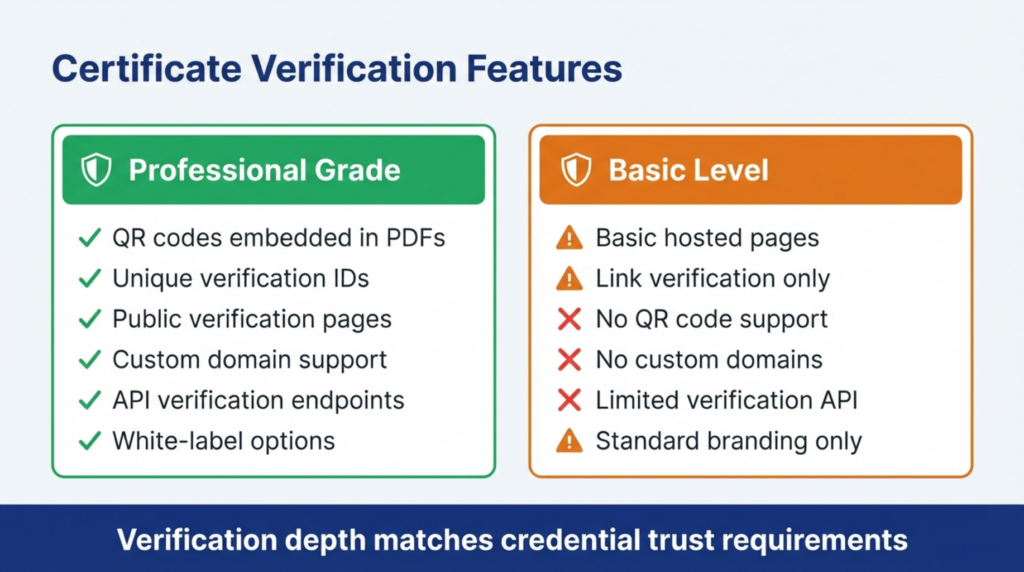
Verification infrastructure reliability affects credential trust and fraud prevention capabilities.
How each platform verifies certificates employs different approaches. MixCertificate embeds unique verification codes and QR links in every certificate connecting to verification pages displaying certificate details, issuance information, and authenticity confirmation. Advanced features include custom domain verification supporting white-label credibility and API verification enabling programmatic authenticity checks. CertifyMe provides basic verification through platform-hosted pages accessed via links without QR code support or advanced verification features.
QR code support enables mobile verification convenience. MixCertificate generates QR codes automatically embedded in certificate PDFs enabling instant smartphone scanning and verification. CertifyMe lacks native QR code generation requiring manual workarounds if QR verification is needed.
Organizations issuing credentials requiring external validation or professional trust should prioritize verification infrastructure depth over basic verification adequacy.
Integration and Ecosystem
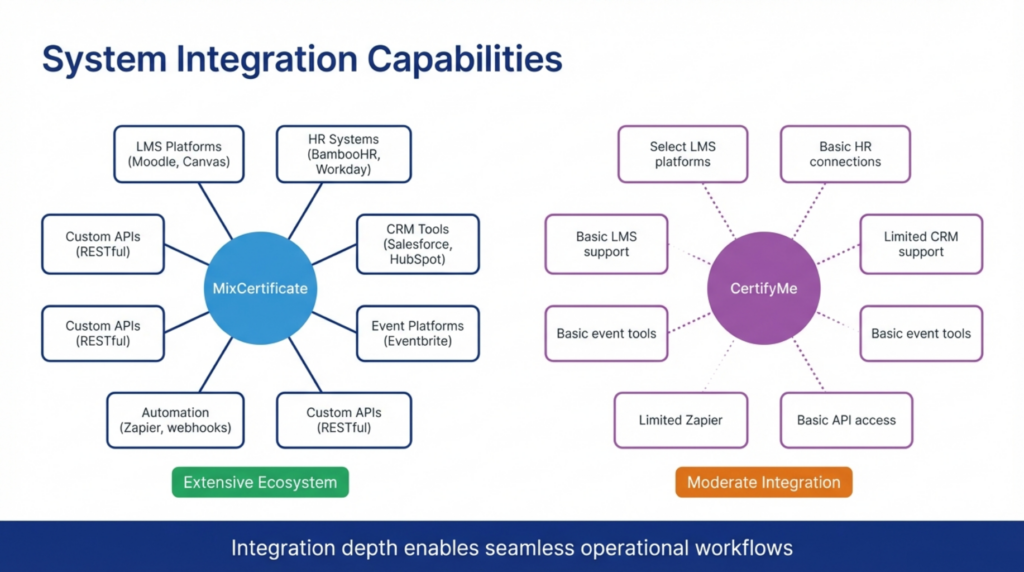
Integration capabilities determine how seamlessly certificate automation fits within existing organizational systems.
Native integrations enable plug-and-play connections. MixCertificate provides pre-built connectors for popular learning management systems including Moodle, Canvas, and Teachable, HR platforms like BambooHR and Workday, CRM tools including Salesforce and HubSpot, and event platforms like Eventbrite and Zoom. CertifyMe offers select integrations with fewer platforms requiring custom development for unlisted systems.
Zapier and webhook support extends integration possibilities. MixCertificate comprehensive webhook system enables integration with thousands of applications through Zapier or direct webhook connections. Custom events trigger workflows across organizational systems creating unified automation. CertifyMe limited webhook support constrains automation possibilities requiring manual workarounds.
Organizations with complex system ecosystems requiring extensive integrations should prioritize platforms offering comprehensive API capabilities and native connector libraries.
Pricing and Operational Considerations
Cost evaluation requires examining subscription fees, operational overhead, and total cost of ownership rather than published pricing alone.
Pricing models employ different structures. MixCertificate uses transparent volume-based pricing scaling predictably as certificate issuance grows with clear feature tier distinctions. CertifyMe employs volume pricing but with less transparency around tier transitions and feature limitations potentially creating unexpected costs.
Cost at scale reveals long-term financial implications. MixCertificate pricing remains competitive at high volumes through efficient infrastructure and predictable scaling. CertifyMe costs may increase disproportionately as volumes grow due to platform constraints and tier limitations.
Budget-conscious organizations should evaluate three-year total cost of ownership including platform fees, staff time, and potential migration costs rather than comparing initial subscription pricing.
Pros and Cons Summary
MixCertificate
Pros:
- Strong automation through API triggers and webhooks
- Detailed reporting and analytics supporting program optimization
- Flexible integrations with extensive native connectors
Cons:
- Higher initial pricing than basic platforms
- More features than minimal needs require
- Learning curve for advanced capabilities
CertifyMe
Pros:
- Easy setup requiring minimal technical expertise
- Simpler workflows suitable for basic use cases
- Lower entry pricing for small teams
- Adequate for modest certificate volumes
Cons:
- Less flexible at scale with volume constraints
- Limited automation requiring manual processes
- Basic verification without advanced features
Which Platform Fits Your Team?
Organizational context determines optimal platform selection beyond feature comparison.
SMBs and small training teams with basic certificate needs under 100 monthly and no complex automation requirements might find CertifyMe initially adequate. Individual trainers, small workshop programs, or modest employee training benefit from accessible automation without extensive features.
Event traffic and repeat workflows requiring regular certificate issuance to hundreds of participants benefit from MixCertificate automation depth and scalability. Event organizers running frequent conferences, webinars, or training sessions need reliable high-volume processing without manual overhead.
Understanding organizational requirements, growth trajectory, and operational sophistication enables appropriate platform selection avoiding under-investment limiting program potential or over-investment implementing unused capabilities.
Frequently Asked Questions (FAQs)
What is the difference between MixCertificate and CertifyMe?
CertifyMe offers accessible certificate automation with simpler features, moderate scalability, basic verification, and straightforward workflows suitable for small to medium teams with modest needs. MixCertificate emphasizes depth and growth readiness.
Can MixCertificate handle bulk certificate generation?
Yes, MixCertificate handles unlimited bulk certificate generation processing thousands of certificates simultaneously without performance constraints. The platform optimizes for high-volume batch processing through parallel processing infrastructure, advanced error handling, data validation, and status tracking.
Is CertifyMe suitable for large training programs?
CertifyMe performs adequately for small to medium training programs with modest certificate volumes under several hundred monthly but experiences limitations for large programs requiring high-volume processing, extensive automation, or complex integrations.
Does MixCertificate support integration via API and webhooks?
Yes, MixCertificate provides comprehensive RESTful API supporting programmatic certificate creation, recipient management, template administration, verification queries, and analytics access.
Which tool is better for automation workflows?
MixCertificate significantly outperforms CertifyMe for automation workflows through API triggers, webhook integration, conditional logic, event-based generation, and extensive system connectivity.
How do verification features compare?
MixCertificate provides advanced verification with QR codes embedded in certificates, unique verification IDs, custom domain verification, public verification pages, and API verification endpoints supporting programmatic authenticity checks. CertifyMe offers basic verification through platform-hosted pages without QR code support or advanced features.
Conclusion
The MixCertificate vs CertifyMe comparison reveals platforms serving different organizational needs and operational maturity stages. MixCertificate provides comprehensive certificate automation infrastructure supporting organizations from inception through substantial growth with unlimited scalability, extensive integrations, advanced verification, and sophisticated automation workflows. CertifyMe offers accessible certificate automation suitable for small to medium teams with straightforward needs, modest volumes, and basic technical requirements.
Explore MixCertificate Pricing Plans for your Organizations should select platforms matching both current operational reality and anticipated growth trajectory. Short-term cost savings through CertifyMe adoption may prove false economy if platform limitations necessitate migration within 12-24 months creating implementation costs and operational disruption exceeding initial savings. Long-term infrastructure investment through MixCertificate selection provides operational continuity supporting program success without platform constraints limiting growth.