
Enterprise organizations require comprehensive understanding of certificate software costs beyond base subscription pricing. Enterprise certificate software cost encompasses licensing models, compliance features, integration complexity, support agreements, and scalability provisions distinguishing enterprise platforms from small business tools. CFOs and procurement leaders need visibility into total cost of ownership, compliance value, and long-term ROI to justify investments and select appropriate vendors.
Traditional certificate creation through design tools or basic software fails at enterprise scale. Organizations issuing thousands to hundreds of thousands of certificates annually require dedicated platforms. Understanding enterprise certificate software cost structures, compliance impacts, and evaluation frameworks helps financial and operational leaders make informed procurement decisions. MixCertificate represents one platform serving enterprise requirements, though organizations should evaluate multiple vendors based on specific needs.
What Is Enterprise Certificate Software?
Enterprise certificate software provides centralized certificate generation, management, verification, and compliance tracking for large organizations. Unlike SMB tools focusing on basic automation, enterprise platforms support complex organizational hierarchies, multi-department workflows, stringent compliance requirements, and integration with existing HR, LMS, and governance systems.
Key differentiators include audit-ready compliance tracking, role-based access controls, comprehensive API integration, white-label customization, dedicated support with service level agreements, and scalability supporting hundreds of thousands of annual certificates. Enterprise certificate software cost reflects these premium capabilities distinguishing platforms from basic automation tools.
Enterprises need dedicated platforms to maintain governance, ensure consistent branding across global operations, provide unified reporting for compliance audits, prevent shadow IT proliferation, and achieve economies of scale. Centralized certificate software eliminates departmental duplication and ensures compliance consistency.
Enterprise Certificate Software Cost Breakdown
Comprehensive enterprise certificate software cost analysis requires examining multiple pricing components beyond advertised subscription rates.
Licensing Models:
Enterprise vendors structure licensing through annual contracts with minimum commitments rather than month-to-month subscriptions. Contract terms span one to three years with volume commitments and auto-renewal clauses. Base platform access fees establish minimum annual costs before usage-based charges apply. MixCertificate and similar enterprise platforms offer flexible licensing accommodating various organizational structures.
Volume-Based Pricing:
Certificate volume directly impacts costs through tiered pricing or per-certificate fees. Organizations issuing 50,000 to 500,000 annual certificates face different pricing than those at 5,000 to 50,000 volumes. Accurate forecasting prevents mid-contract tier upgrades carrying premium costs.
Integration & API Access:
Enterprise system integration represents significant cost factors. API access for HRIS integration, LMS connectivity, single sign-on authentication, and data warehouse synchronization often tier by API call volume. Organizations requiring real-time bidirectional data synchronization pay more than those using periodic batch imports. MixCertificate provides comprehensive API documentation and integration support as part of enterprise agreements.
Support & Service Level Agreements:
Enterprise support differs dramatically from standard tiers. Dedicated account management, guaranteed response times, 24/7 availability, and priority escalation channels carry substantial premiums. Organizations requiring 99.9% uptime guarantees pay accordingly for these commitments.
Implementation Fees:
Initial implementation includes professional services for configuration, data migration, integration development, staff training, and go-live support. Setup fees range from included in enterprise contracts to separate charges depending on complexity.
Recent reporting highlights how bogus academic qualifications can be highly profitable for fraudsters, with fake degrees being sold for thousands of dollars in what some commentators are calling “the great degree scam“.
Compliance Requirements That Impact Cost
Regulatory compliance directly influences enterprise certificate software cost through specialized features, audit infrastructure, and data governance provisions.
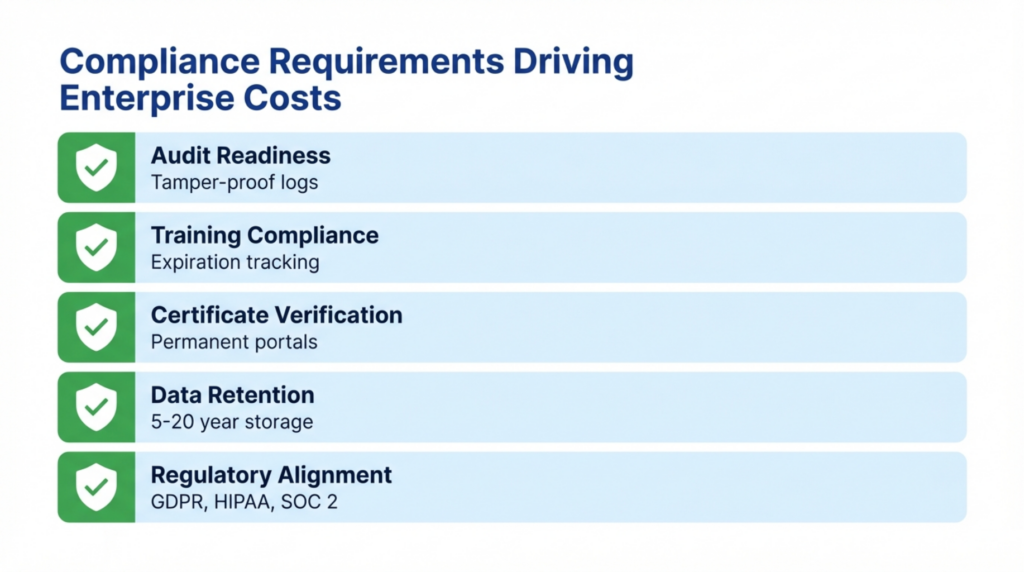
Audit Readiness:
Compliance-focused organizations require comprehensive audit trails documenting who issued which certificates, when issuance occurred, and who accessed records. Maintaining tamper-proof audit logs for regulatory retention periods requires robust infrastructure increasing platform costs. MixCertificate and other enterprise solutions include audit logging as standard compliance features.
Training Compliance Tracking:
Industries with mandatory training requirements need platforms tracking completion, managing expiration dates, triggering renewal notifications, and generating compliance reports. Healthcare, financial services, manufacturing, and government sectors face strict training compliance mandates requiring specialized functionality.
Certificate Verification:
Permanent, publicly accessible verification protecting against credential fraud requires ongoing infrastructure investment. Enterprise platforms maintain verification portals, QR code systems, and unique identifier databases indefinitely. Organizations issuing credentials for professional licensing require verification capabilities justifying premium pricing.
Data Retention Policies:
Regulatory requirements mandate long-term certificate record retention spanning five to twenty years depending on industry. Enterprise certificate software cost reflects infrastructure supporting decades-long retention and ensuring data recoverability.
Regulatory Alignment:
Industry-specific compliance including GDPR, HIPAA, SOC 2, and sector-specific regulations demand platform security certifications. Vendors maintaining these certifications pass associated costs to enterprise customers.
Concerns over fake academic credentials have also entered political discussions abroad, with some policymakers linking fake degree busts to broader issues of visa integrity and credential verification.
Reporting, Governance & Risk Management
Enterprise certificate software cost includes comprehensive reporting and governance capabilities justifying investment through compliance value and operational visibility.
Enterprise Reporting Needs:
Executive leadership requires consolidated reporting showing training completion rates, compliance status, and program effectiveness across departments, locations, and business units. Finance teams need cost-per-certificate analysis. Compliance officers demand audit-ready documentation.
Centralized Certificate Records:
Unified certificate databases eliminate departmental silos and shadow IT risks. Centralization ensures consistent data standards, prevents duplicate records, and facilitates organizational changes. Enterprise platforms like MixCertificate support multi-department access with appropriate permission controls.
Exportable Audit Logs:
Regulatory audits require rapid production of complete certificate records. Enterprise platforms export comprehensive audit logs in regulator-specified formats, reducing audit preparation from weeks to hours.
Risk Reduction Through Traceability:
Complete certificate lifecycle traceability reduces organizational risk. Platforms maintaining comprehensive records protect against fraud claims, credential disputes, and compliance violations.
Coverage from International news outlets describes how fake degree scams across India have sparked political controversy in Australia, underscoring the need for robust digital credential verification systems.
Integration & Automation at Enterprise Scale
Enterprise certificate software cost correlates directly with integration complexity and automation sophistication required for large-scale operations.
HRIS Integration:
Bidirectional integration with enterprise HR systems enables automatic employee data population and real-time organizational updates. Deep HRIS integration eliminates manual data entry and maintains data consistency.
LMS Integration:
Learning management system connectivity allows automatic certificate generation upon course completion. MixCertificate provides LMS integration through APIs and webhooks, automating certificate issuance without manual intervention.
API Workflows:
Custom workflow automation through APIs enables sophisticated certificate processes. Conditional certificate generation based on business rules and multi-stage approval workflows require extensive API capabilities.
Automation for High-Volume Issuance:
Processing tens of thousands of certificates monthly demands robust automation infrastructure. Batch processing capabilities and reliable delivery systems require significant platform investment reflected in enterprise certificate software cost.
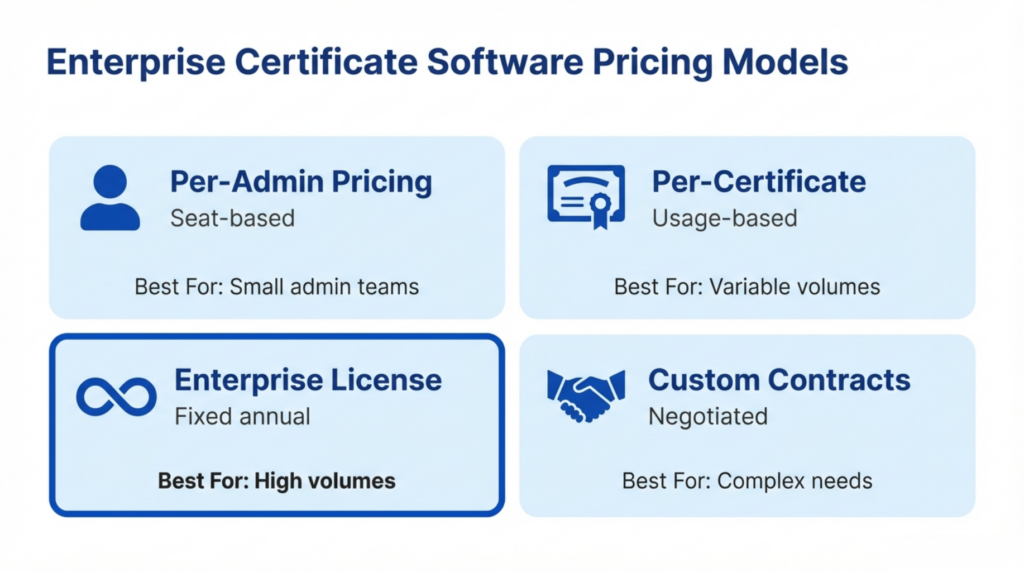
Enterprise Certificate Software Pricing Models
Understanding various enterprise certificate software cost structures enables organizations to select pricing models matching usage patterns and budget preferences.
Per-Admin Pricing:
Some vendors charge based on administrator seat count rather than certificate volume. This model benefits organizations with small administrative teams issuing high volumes but becomes expensive for enterprises requiring departmental access.
Per-Certificate Pricing:
Usage-based pricing charges per certificate generated, creating perfect cost alignment with actual usage but potentially producing unpredictable budgets. Large enterprises negotiating volume commitments typically receive significant discounts.
Enterprise License Models:
Unlimited certificate generation within fixed annual fees provides maximum budget predictability. Enterprise licenses suit organizations with high or unpredictable volumes. MixCertificate typically structures pricing based on organizational size rather than certificate volume.
Custom Contracts:
Large enterprises often negotiate custom agreements reflecting specific requirements. Custom pricing accounts for unique integration needs, service level requirements, and data residency requirements.
Total Cost of Ownership for Enterprises
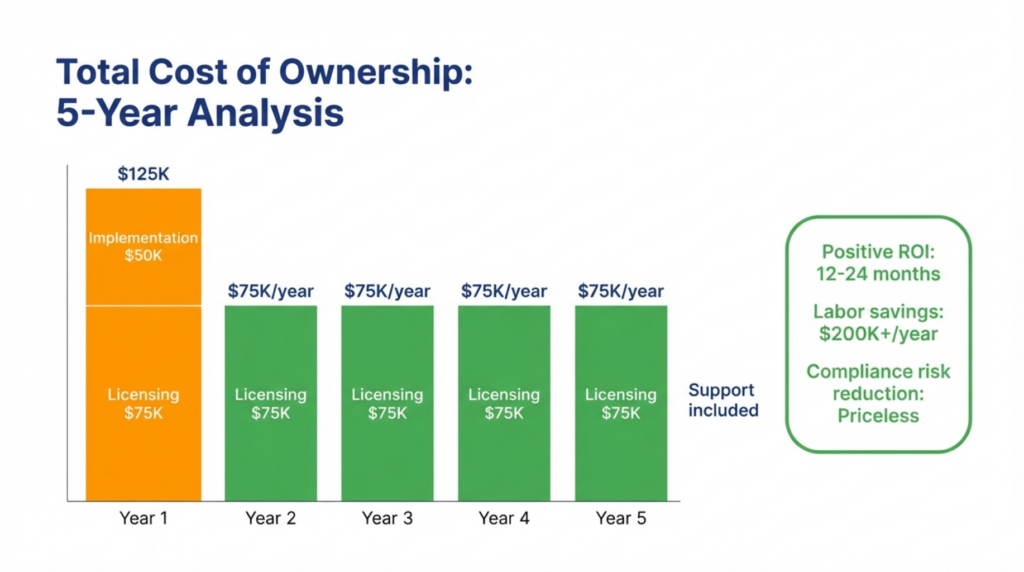
Comprehensive enterprise certificate software cost evaluation extends beyond subscription fees to encompass total cost of ownership over multi-year implementations.
Upfront Versus Long-Term Costs:
Initial investments include software licenses, professional services, integration development, and training. Long-term costs include annual renewals, ongoing support, and volume tier escalations. Enterprise procurement should evaluate total five-year costs.
Operational Savings:
Certificate automation eliminates substantial manual labor. Organizations generating 100,000 annual certificates manually would require multiple full-time staff. Enterprise certificate software cost of $50,000 annually justifies itself against $200,000+ in manual processing labor.
Compliance Risk Avoidance:
Regulatory violations from inadequate training documentation carry substantial penalties. Enterprise certificate software cost represents compliance insurance, maintaining audit-ready documentation preventing violation risks.
Long-Term Value:
Most enterprises find automation platforms deliver positive ROI within 12 to 24 months through labor savings, risk reduction, and efficiency gains. MixCertificate provides TCO modeling tools helping organizations quantify expected returns.
Enterprise Certificate Software Options
Enterprises evaluating vendors should assess multiple dimensions beyond pricing to ensure platform selection supports long-term organizational needs.
Compliance Readiness:
Platforms must provide industry-specific compliance features relevant to organizational requirements. Healthcare organizations need HIPAA-compliant platforms. Financial services require SEC compliance capabilities. Vendors should demonstrate compliance certifications.
Scalability:
Enterprise growth requires platforms scaling seamlessly from thousands to hundreds of thousands of annual certificates without performance degradation. Evaluate vendor infrastructure and enterprise customer base size as scalability indicators.
Reporting Depth:
Executive dashboards, compliance reporting, and operational metrics must meet enterprise information needs. Reporting capabilities should align with organizational governance requirements.
Vendor Support Maturity:
Enterprise implementations require responsive, knowledgeable support. MixCertificate provides dedicated account management and priority support for enterprise customers, ensuring implementation success and operational excellence.
Pros and Cons of Enterprise Certificate Software
Advantages from CFO Perspective:
- Substantial labor cost reduction through automation versus manual processes
- Compliance risk mitigation preventing regulatory violations and penalties
- Centralized governance eliminating shadow IT and departmental tool proliferation
- Audit readiness reducing compliance staff requirements
- Operational efficiency enabling training teams to scale without proportional headcount
- Analytics visibility providing executive insight into training effectiveness
- Vendor support mitigating implementation risks
Limitations Requiring Consideration:
- Significant upfront investment requiring multi-year budget commitments
- Implementation complexity demanding organizational change management
- Integration challenges with legacy systems potentially requiring custom development
- Vendor dependency creating switching costs and platform lock-in
- Contract inflexibility limiting ability to adjust commitments
How CFOs Should Evaluate Enterprise Certificate Software Cost ?
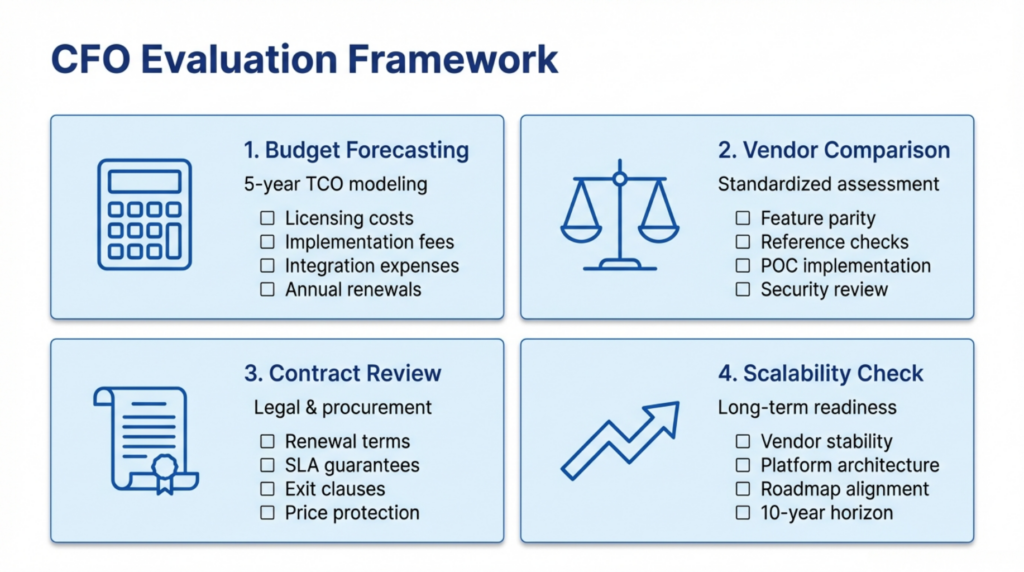
Budget Forecasting Framework:
Accurate enterprise certificate software cost projections require five-year modeling including licensing, implementation, integration, and operational expenses. Compare total costs against current manual processing expenses and compliance risk reduction value. Build scenarios reflecting different volume growth projections.
Vendor Comparison Methodology:
Comparing enterprise certificate software cost across vendors requires standardized analysis covering all fee components beyond base pricing. Request detailed pricing covering all cost components. Obtain references from similar-sized organizations. MixCertificate and other vendors provide evaluation frameworks supporting structured assessments.
Contract Review Priorities:
Engage legal and procurement teams for contract evaluation. Scrutinize renewal terms, price escalation clauses, termination provisions, and liability limitations. Negotiate service level agreements with clear performance metrics.
Long-Term Scalability Assessment:
Evaluate vendor financial stability and product roadmap alignment with organizational needs. Assess platform architecture supporting anticipated growth. Select platforms supporting decade-long operational horizons.
Frequently Asked Questions
What is the typical enterprise certificate software cost?
Understanding typical enterprise certificate software cost ranges helps organizations budget appropriately. Small enterprises (1,000-5,000 employees) typically invest $5,000-$25,000 annually. Mid-size enterprises (5,000-20,000 employees) budget $25,000-$100,000 annually. Large global organizations (20,000+ employees) invest $100,000-$500,000+ annually depending on complexity, integration requirements, and certificate volumes. These costs include licensing, implementation, integration, and support.
Why is enterprise certificate software more expensive than SMB tools?
Enterprise certificate software cost premiums reflect substantial additional capabilities including compliance-grade audit trails, sophisticated reporting and analytics, enterprise system integration, dedicated support with SLAs, white-label customization, role-based access controls, and infrastructure supporting massive scale. Development, security certifications, and support infrastructure for enterprise requirements justify premium pricing over basic SMB automation tools.
Does enterprise certificate software include compliance features?
Quality enterprise platforms like MixCertificate include comprehensive compliance features as standard rather than optional add-ons. Essential compliance capabilities include audit trails, tamper-proof records, certificate verification systems, regulatory reporting, data retention management, and exportable compliance documentation. Organizations should verify specific compliance features address their industry requirements during vendor evaluation.
How does certificate software reduce compliance risk?
Enterprise certificate software reduces compliance risk through systematic documentation of training completion, automated expiration tracking preventing lapses, audit-ready reporting simplifying regulatory reviews, verification systems preventing credential fraud, and centralized records eliminating documentation gaps. Automated compliance reduces human error risk while providing defensible documentation for regulatory audits.
Can enterprise certificate software scale globally?
Enterprise platforms support global deployment through multi-language certificate generation, timezone-aware operations, regional data residency compliance, multi-currency support, and distributed architecture serving global user bases. MixCertificate and comparable platforms support multinational organizations with thousands of users across multiple continents.
Is MixCertificate suitable for enterprise use?
MixCertificate provides enterprise-grade certificate software serving large organizations with sophisticated requirements. The platform offers compliance features, enterprise integrations, dedicated support, white-label customization, and scalability supporting hundreds of thousands of annual certificates. MixCertificate enterprise plans include audit trails, sophisticated reporting, API access, and dedicated account management necessary for large organizational deployments.
Conclusion
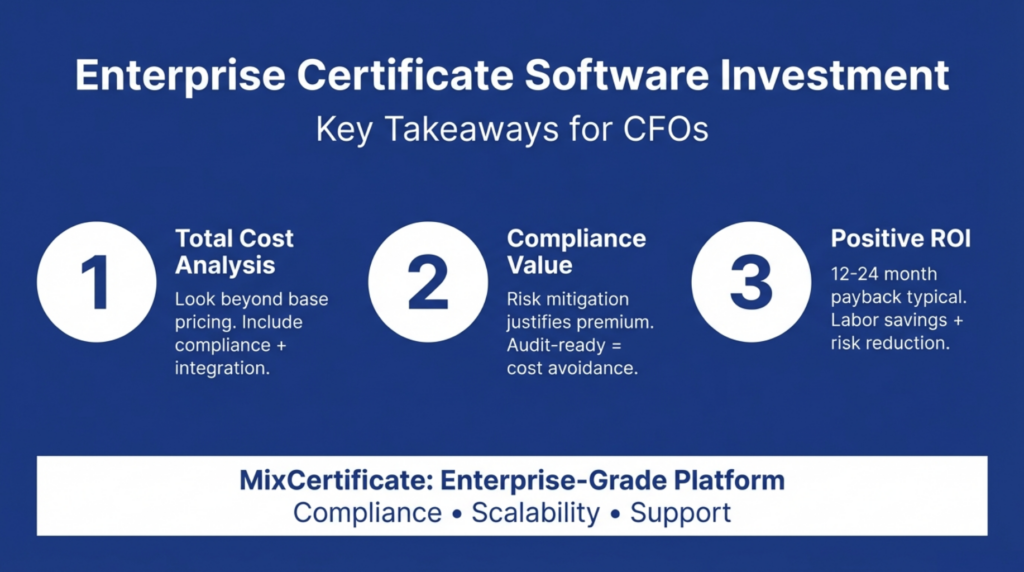
Enterprise certificate software cost reflects comprehensive capabilities supporting organizational scale, compliance requirements, and operational governance distinguishing enterprise platforms from SMB alternatives. Evaluating enterprise certificate software cost requires understanding total cost of ownership encompassing licensing, implementation, integration, and support expenses over multi-year horizons.
Effective evaluation compares costs against manual processing expenses, compliance risk mitigation value, and operational efficiency gains. Most enterprises achieve positive ROI within 12 to 24 months through labor savings and risk reduction despite significant upfront investment in enterprise certificate software cost.
MixCertificate represents one platform serving enterprise requirements with appropriate compliance capabilities, integration flexibility, and vendor maturity. Organizations should evaluate multiple vendors through structured assessments ensuring selected platforms align with compliance needs, integration requirements, scalability expectations, and budget parameters supporting long-term certificate management success.
