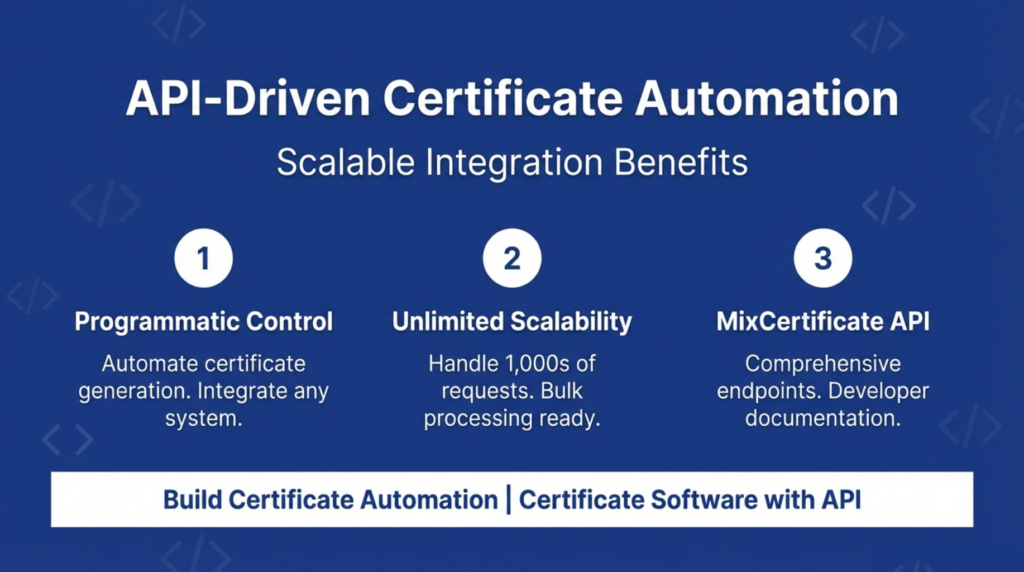
Organizations managing high-volume certificate operations require programmatic control beyond manual workflows or user interfaces. Certificate software with API enables automated credential generation through direct system integration, allowing platforms to trigger certificate creation programmatically. API-based automation supports scalable certificate operations where manual processes become impractical due to volume, complexity, or integration requirements.
Traditional certificate tools requiring manual data entry create operational bottlenecks limiting scalability. Certificate software with API eliminates these constraints by enabling external systems to generate certificates through programmatic requests. Learning management systems, HR platforms, and custom applications integrate directly with certificate APIs automating credential issuance. MixCertificate represents one platform providing comprehensive API access enabling organizations to build automated workflows.
What Is Certificate Software with API?
Certificate software with API provides programmatic interfaces enabling external systems to generate certificates through code rather than manual interaction. APIs accept certificate generation requests from authorized systems, process provided data, create credentials, and return results programmatically eliminating manual data entry.
API-driven systems differ from UI-based tools. User interface tools require human operators to input data manually. Certificate software with API accepts structured requests from software applications, automatically processes information, generates certificates, and delivers credentials without human involvement. MixCertificate provides comprehensive API documentation supporting individual certificate generation and bulk processing through programmatic requests.
Organizations implement APIs when manual processes cannot scale. High-volume issuance, real-time delivery requirements, complex integrations, and automated workflows drive API adoption enabling organizations to issue thousands of certificates without proportional staffing increases.
How API-Based Certificate Workflows Operate
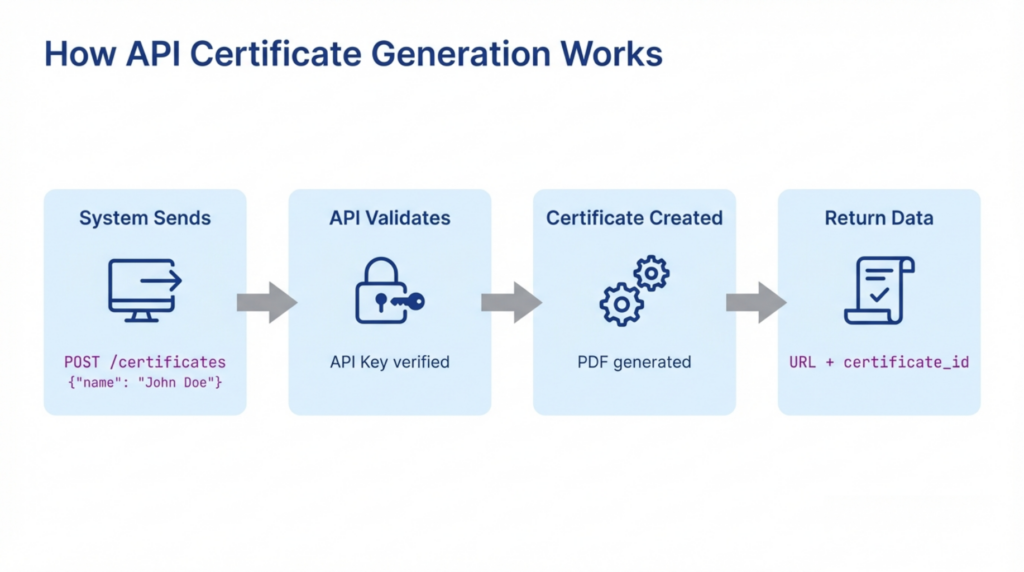
External System Sends Request: Workflows begin when applications send API requests to certificate platforms. Learning systems send requests after course completions. HR platforms send requests when employees finish training. Requests include structured data containing recipient information and certificate parameters.
API Receives Data: Certificate platforms receive requests at designated endpoints. Authentication validates request sources. Request validation confirms data completeness. MixCertificate API parses incoming requests extracting recipient names, achievement descriptions, and dates.
Certificate Generated: Platforms generate certificates applying provided data to templates. Generation engines create PDF or image credentials containing personalized information. MixCertificate processes requests generating certificates matching organizational branding through flexible template systems.
Delivery or Storage: Generated certificates deliver to recipients or store in designated locations based on request parameters. Email delivery sends certificates directly. Cloud storage saves certificates to organizational systems. API responses return certificate URLs enabling requesting systems to manage distribution.
Common API Workflows for Certificate Software
LMS Completion to API Certificate: Learning platforms integrate triggering credential generation upon course completion. When students finish courses, platforms send API requests containing student data. Certificate software with API generates completion certificates and returns credentials for distribution. MixCertificate supports major LMS integrations through standard API patterns.
HR System to Employee Certificates: HR systems integrate APIs for automated employee training credential management. When employees complete training, HR systems send requests triggering generation. MixCertificate creates employee training certificates reflecting organizational branding.
Custom SaaS to Bulk Generation: Custom applications implement APIs for high-volume credential issuance. Training platforms send bulk requests containing multiple recipient records. Certificate software with API processes batch requests generating hundreds simultaneously. MixCertificate supports bulk operations enabling efficient high-volume processing.
Compliance Platform to Renewal: Compliance systems integrate APIs automating recertification. When professionals complete requirements, platforms send requests generating updated certificates with new expiration dates. MixCertificate maintains historical records while issuing current credentials.
Certificate Automation Use Cases
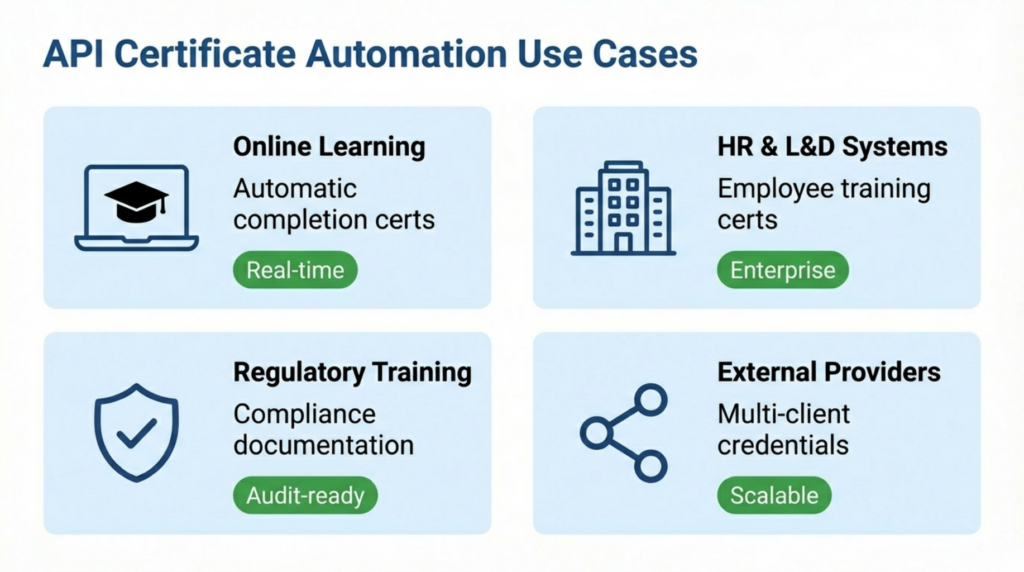
LMS and Online Learning Platforms
Educational platforms use certificate software with API to automate student credential delivery. Online course providers and universities integrate certificate APIs triggering automatic generation upon completion. MixCertificate provides API documentation enabling LMS developers to implement certificate automation supporting diverse educational models.
Corporate HR & L&D Systems
Enterprise organizations integrate APIs into HR and learning technology stacks. Systems trigger certificate generation when employees complete onboarding, compliance training, or professional certification. MixCertificate API supports enterprise authentication standards enabling large organizations to automate credential management at scale.
Compliance & Certification Programs
Industries with regulatory requirements use APIs to automate compliance credential management. Healthcare providers, financial services, and manufacturing organizations integrate tracking systems with certificate APIs. MixCertificate supports compliance workflows through API features including audit logging, verification, and long-term retention.
External Training Providers
Training companies and certification bodies implement APIs delivering client credentials. Training platforms integrate APIs generating branded certificates reflecting client organizations. MixCertificate API flexibility supports diverse client branding requirements enabling training providers to offer comprehensive credentialing services.
Step-by-Step: Setting Up Certificate Software with API
Review API Documentation: Examine platform API documentation understanding available endpoints, request formats, and authentication requirements. MixCertificate provides comprehensive API documentation including request examples and integration guidance.
Generate API Credentials: Create authentication credentials enabling secure API access. Platforms provide API keys or OAuth tokens. Store credentials securely following organizational security practices.
Define Certificate Data Fields: Map data fields from triggering systems to certificate parameters. Identify which fields correspond to recipient names, achievement descriptions, and dates ensuring accurate certificate population.
Configure Automation Trigger: Establish triggering logic determining when systems send generation requests. Define events initiating API calls such as course completions or training finishes.
Test API Responses: Execute test requests using sample data validating proper generation before production. Verify certificates generate correctly. MixCertificate provides testing environments enabling validation before activation.
Monitor Usage and Errors: Monitor API request volumes, success rates, and error occurrences. Establish monitoring systems alerting administrators to integration failures.
Benefits of API-Based Certificate Software 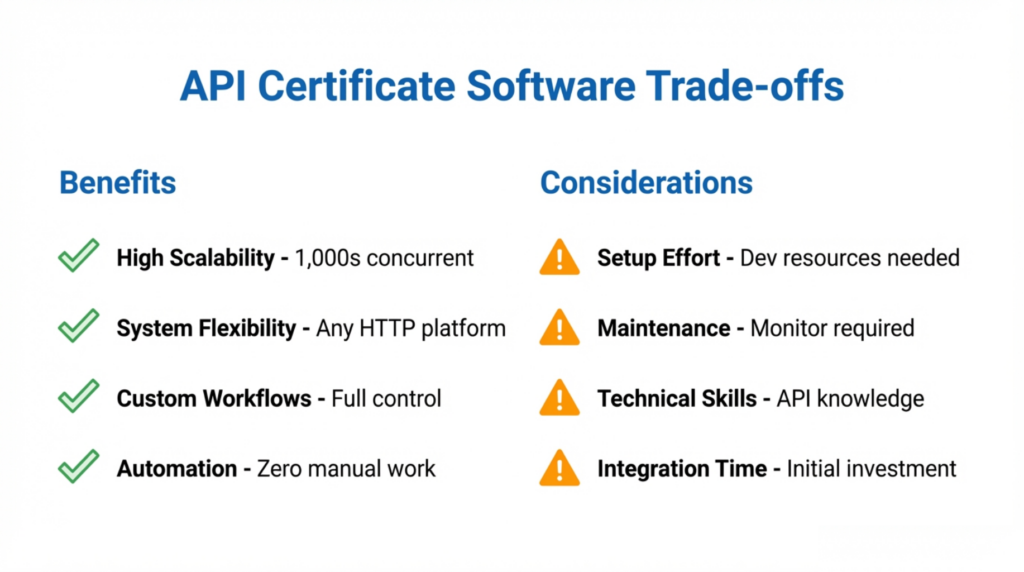
High Scalability: Certificate software with API scales efficiently handling increasing volumes without manual bottlenecks. Organizations generate thousands during peak periods without degradation.
System Flexibility: API integration enables generation from any system capable of making HTTP requests. Organizations integrate diverse platforms including commercial software and custom applications.
Custom Workflows: Organizations design certificate workflows matching operational requirements through API integration. MixCertificate API flexibility supports diverse requirements through comprehensive endpoint coverage.
Reduced Manual Processing: API automation eliminates repetitive manual tasks freeing staff for higher-value activities. Organizations reclaim hundreds of administrative hours monthly.
Automation Reliability: Certificate software with API provides stable programmatic interfaces supporting long-term automation investments with minimal ongoing maintenance.
Limitations and Considerations
Initial Setup Effort: API integration requires technical implementation including credential configuration, request formatting, and testing. Organizations need development resources implementing certificate software with API.
Maintenance Responsibilities: API workflows require ongoing monitoring ensuring reliable operation. Organizations must track usage, investigate failures, and update integrations when platforms release changes.
Development Resource Dependency: Implementing APIs typically requires software development capabilities. Organizations without technical resources may need external assistance or should evaluate no-code alternatives.
When No-Code Tools May Be Better: Organizations with simple workflows, limited resources, or low volumes may benefit from no-code tools rather than direct API implementation.
Certificate Software That Offers API Access
API Reliability: Platforms must maintain stable, well-documented APIs supporting long-term integration investments. Evaluate vendor uptime history and versioning practices.
Documentation Quality: Comprehensive documentation covering endpoints, authentication, and error codes enables successful integration. MixCertificate provides detailed API documentation supporting developers implementing automation.
Data Security: API implementations must protect sensitive data through encryption, secure authentication, and access controls. Organizations require platforms meeting specific security standards.
Reporting and Logs: API analytics and request logging enable monitoring. Platforms should provide dashboards showing request volumes, success rates, and performance metrics.
Pros and Cons of Certificate Software with API
Advantages:
- Programmatic control enabling automated workflows
- High scalability supporting thousands of concurrent requests
- System-agnostic integration with any platform
- Custom workflow implementation
- Elimination of manual processing
- Long-term automation reliability
- Efficient bulk generation capabilities
- Direct integration reducing dependencies
Limitations:
- Technical implementation requiring expertise
- Ongoing maintenance demanding monitoring
- Initial setup investment
- Dependency on development resources
- Troubleshooting complexity
- Security implementation responsibilities
- Learning curve for unfamiliar teams
Frequently Asked Questions
What is certificate software with API?
Certificate software with API provides programmatic interfaces enabling external systems to generate certificates automatically through code rather than manual interaction. APIs accept structured requests containing recipient data and parameters, generate credentials, and return results programmatically. This eliminates manual processing enabling scalable operations supporting high-volume requirements and complex integrations.
How does API-based certificate automation work?
API automation works by enabling applications to send certificate generation requests programmatically. When triggering events occur—course completions, training finishes—systems send HTTP requests to certificate APIs containing participant data. Certificate software with API receives requests, validates data, generates credentials, and delivers certificates automatically without human intervention enabling real-time issuance at scale.
Is certificate software with API scalable?
Yes, certificate software with API scales efficiently handling high volumes through programmatic generation architecture. Platforms process thousands of concurrent requests generating certificates without manual bottlenecks. MixCertificate supports bulk generation requests enabling organizations to process hundreds simultaneously. Horizontal scaling ensures consistent performance as volumes increase supporting growth and peak demands.
Do HR teams need developers to use APIs?
Certificate software with API typically requires development resources for initial integration including authentication configuration, request formatting, and error handling. Organizations need software developers implementing API connections. After setup, HR teams operate workflows through triggering systems without ongoing developer involvement. MixCertificate provides implementation documentation supporting technical teams establishing automation serving HR needs.
Does MixCertificate provide API access?
Yes, MixCertificate provides comprehensive API access supporting automated certificate generation workflows. The platform offers documented endpoints for individual and bulk creation, delivery configuration, verification management, and usage reporting. MixCertificate API supports standard authentication methods, provides detailed documentation, and includes testing environments enabling organizations to implement automation matching their technical architecture and operational requirements.
Conclusion
Certificate software with API enables scalable automated credential generation through programmatic integration with organizational systems. API automation eliminates manual processing supporting high-volume operations impossible through user interface tools. Organizations implement APIs integrating learning platforms, HR systems, compliance tools, and custom applications triggering automated generation.
Understanding workflow structures, integration patterns, implementation requirements, and considerations enables organizations to evaluate whether certificate software with API matches technical capabilities and automation requirements. Explore MixCertificate Pricing Plans for your organization and Benefits including scalability, flexibility, customization, and reduced processing justify API integration investment for organizations with development resources and significant volumes.
MixCertificate represents one platform providing robust API access supporting diverse automation workflows through comprehensive endpoint coverage, detailed documentation, and flexible customization. Organizations should evaluate multiple certificate software with API platforms assessing reliability, documentation quality, security, and reporting. Successful implementations deliver efficiency gains, improved delivery speed, and scalable management while providing verification capabilities combating credential fraud as highlighted in recent global investigations.