Introduction
LMS certificate automation transforms how organizations manage training credentials by eliminating manual certificate creation and delivery. Training managers spend countless hours generating, tracking, and distributing certificates across learner populations.
Automated certificate systems integrate with learning management platforms to issue verified credentials instantly upon course completion. This eliminates bottlenecks that delay recognition and creates compliance risks in regulated industries.
What Is LMS Certificate Automation?
LMS certificate automation generates and delivers training certificates automatically when learners complete courses or meet defined criteria. The system eliminates manual certificate creation by triggering credential issuance based on LMS completion data.
Modern LMS platforms offer two certificate automation approaches:
Built-in LMS certificates use native platform tools to generate basic certificates with limited customization. These work for simple use cases but often lack branding control and verification features.
External certificate automation tools like MixCertificate integrate with LMS platforms through APIs or webhooks to provide advanced customization, compliance tracking, and verification capabilities. MixCertificate connects with major LMS platforms to automate certificate workflows while maintaining brand consistency across training programs.
The difference matters for organizations requiring audit trails, credential verification, or certificates that transfer across multiple systems.
LMS Certificate Automation Workflow
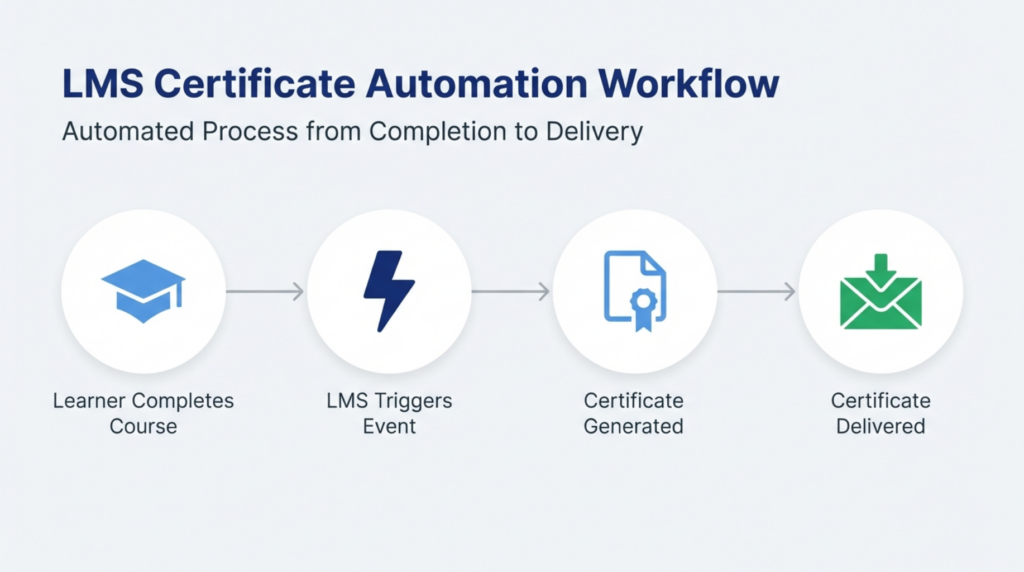
The standard LMS certificate automation workflow follows these steps:
- Learner completes course or module – The LMS records completion status when learners finish required content and pass assessments.
- LMS triggers completion event – Upon completion, the platform generates an API call, webhook notification, or internal event signal.
- Certificate automation system generates certificate – The connected system (built-in or external like MixCertificate receives the trigger and creates a personalized certificate with learner data, completion date, and credential details.
- Certificate delivered or stored – The generated certificate reaches learners through email, LMS download, or credential wallet while creating permanent records for verification.
This workflow scales from single courses to enterprise-wide training programs without manual intervention. MixCertificate enhances this flow by adding verification layers and compliance documentation that standard LMS tools often lack.
Common LMS Platforms Used for Certificate Automation
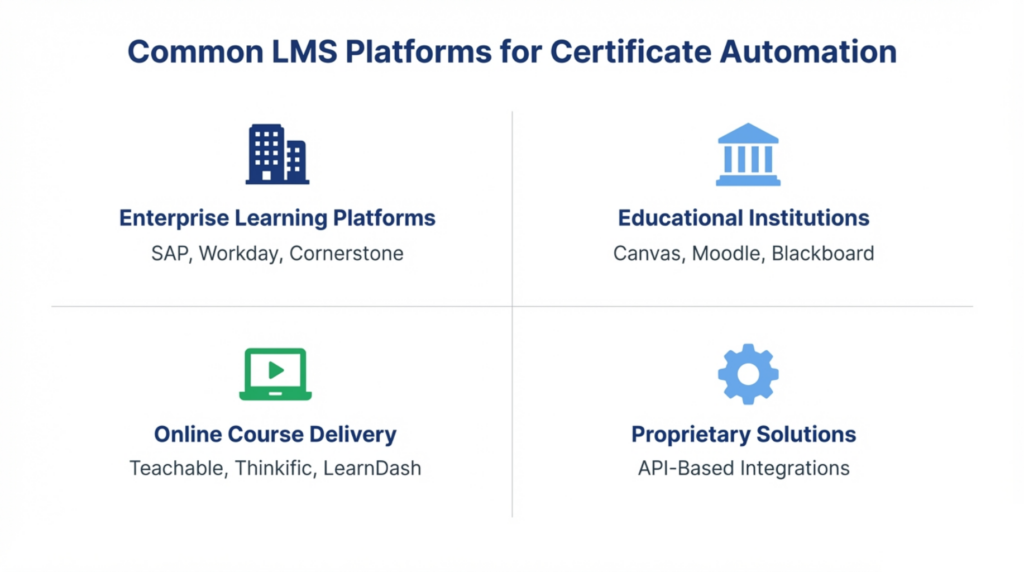
Organizations deploy certificate automation across diverse LMS environments:
Corporate LMS
Enterprise platforms like SAP SuccessFactors, Workday Learning, and Cornerstone OnDemand support certificate automation through API integrations. These systems prioritize compliance tracking and reporting for regulated industries.
Corporate LMS platforms often require external tools like MixCertificate to achieve full branding control and credential portability across organizational boundaries.
Academic LMS
Canvas, Moodle, and Blackboard serve educational institutions with built-in certificate features. Academic platforms emphasize transcript integration and academic record keeping.
However, institutions increasingly supplement native tools with dedicated certificate platforms like MixCertificate for professional development programs that require industry-recognized credentials.
Online Course Platforms
Teachable, Thinkific, and LearnDash power online course delivery with varying certificate automation capabilities. Platform limitations often drive course creators toward specialized certificate tools.
MixCertificate integrates with these platforms to provide consistent credential experiences across multiple course environments.
Custom LMS Solutions
Organizations building proprietary LMS platforms rely on API-based certificate automation. Custom implementations require flexible integration options that platforms like MixCertificate provide through REST APIs and webhook support.
LMS Certificate Automation Use Cases
Employee Training & Onboarding
New hire programs require certificates documenting completion of mandatory training modules. LMS certificate automation ensures every employee receives standardized credentials proving policy acknowledgment and skills acquisition.
MixCertificate supports onboarding workflows by maintaining permanent records that survive employee transitions and system migrations.
Compliance & Mandatory Training
Regulated industries face strict requirements for documenting compliance training completion. Financial services, healthcare, and manufacturing organizations need audit-ready certificate records with timestamps and verification capabilities.
External certificate systems like MixCertificate provide compliance teams with centralized tracking and instant verification that basic LMS certificates cannot match.
Professional Skill Development
Continuous learning programs certifying technical skills, leadership competencies, and professional development benefit from portable credentials. Employees value certificates they can share across platforms and include in professional profiles.
MixCertificate enables skill development programs to issue credentials that learners control and share beyond organizational LMS boundaries.
External Training & Certification Programs
Organizations offering training to customers, partners, or public learners require professional-grade certificates. These programs demand branded credentials with verification links and expiration tracking.
Certificate automation tools like MixCertificate transform standard LMS platforms into credentialing systems that support external training revenue models.
LMS Certificate Automation Setup Options
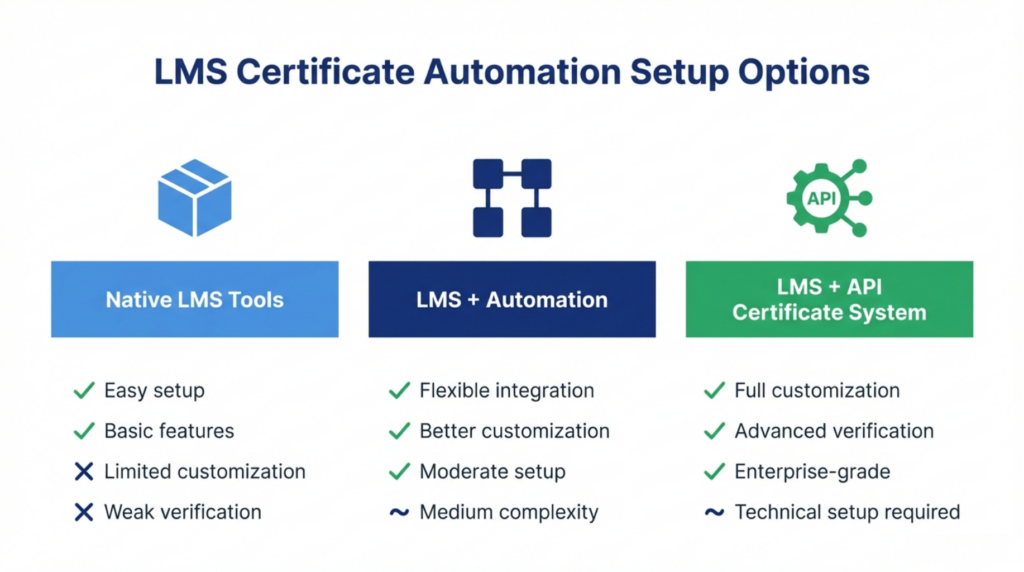
Training teams select from three primary setup approaches:
Native LMS Certificate Tools
Most learning platforms include basic certificate generators requiring minimal setup. Administrators configure certificate templates within the LMS interface and map them to course completion rules.
This approach works for internal training programs with simple requirements. However, limited customization and reporting capabilities restrict scalability.
LMS + Automation Tools
Integrating workflow automation platforms like Zapier or Make with LMS webhooks enables certificate generation through connected services. This middle-ground solution provides more flexibility than native tools.
Organizations using this approach often connect their LMS to MixCertificate through automation platforms to combine ease of setup with professional certificate features.
LMS + API-Based Certificate Software
Enterprise implementations leverage direct API integrations between LMS platforms and dedicated certificate systems. This approach provides maximum control over certificate workflows, data synchronization, and verification systems.
MixCertificate offers API-first architecture that supports custom integrations across any LMS platform capable of sending completion data through webhooks or REST APIs.
Setup complexity increases with flexibility, but proper implementation creates sustainable certificate automation that scales with organizational growth.
Benefits of Automating Certificates in LMS
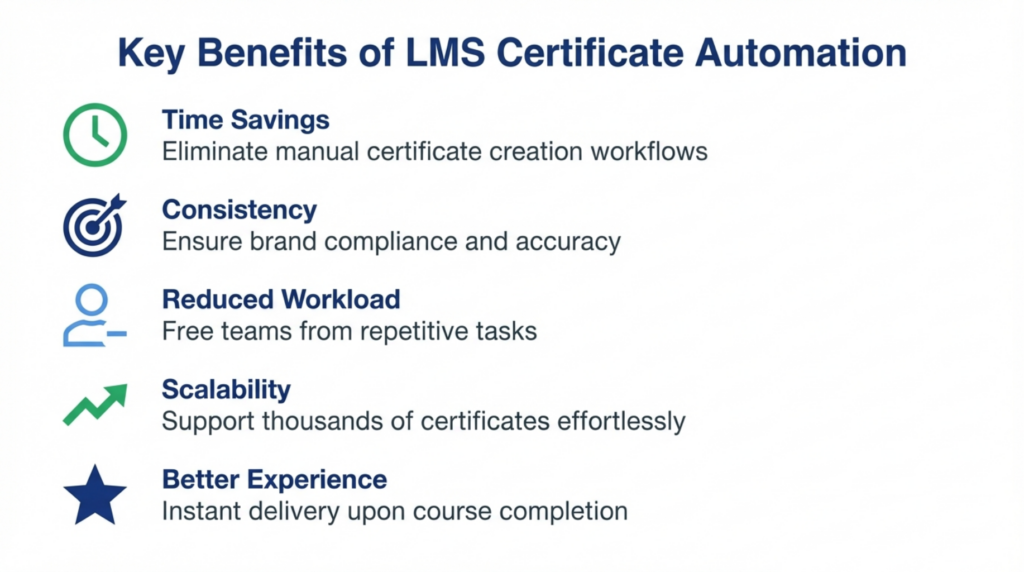
Certificate automation delivers measurable operational improvements:
Time savings eliminate hours spent manually creating, personalizing, and distributing certificates. Training administrators redirect effort toward program improvement instead of certificate production.
Consistency ensures every certificate follows brand guidelines and includes required information. Automated systems eliminate human errors in names, dates, and credential details.
Reduced administrative workload frees training teams from repetitive tasks. Certificate automation removes bottlenecks that delay credential delivery and frustrate learners.
Scalable certificate issuance supports growth from dozens to thousands of certificates without proportional staff increases. Organizations expand training programs without expanding certificate production teams.
Improved learner experience provides instant credential access upon completion. Automated delivery through email or LMS downloads creates positive program endings that encourage continued engagement.
Systems like MixCertificate amplify these benefits by adding verification features and credential management capabilities that transform certificates from completion records into portable professional assets.
Limitations of LMS-Only Certificate Automation
Standard LMS certificate features present operational constraints:
Limited branding control restricts certificate designs to platform templates. Organizations struggle to create certificates that match brand guidelines or differentiate programs visually.
Weak reporting and verification make it difficult to track certificate usage, validate authenticity, or provide third-party verification. Basic LMS tools lack the infrastructure for credential verification systems.
Poor portability across systems traps certificates inside specific LMS platforms. Learners cannot easily transfer credentials when organizations migrate platforms or consolidate training systems.
Challenges with compliance tracking emerge when regulations require specific certificate formats, retention periods, or verification capabilities beyond LMS platform capabilities.
These limitations explain why organizations supplement LMS platforms with dedicated certificate systems like MixCertificate rather than relying solely on built-in tools.
LMS Certificate Automation Tools & Platforms
Evaluating certificate automation solutions requires examining key technical and operational factors:
Integration methods determine how easily certificate systems connect with existing LMS platforms. Look for tools supporting multiple integration patterns including webhooks, REST APIs, and automation platform connectors.
MixCertificate provides flexible integration options that work with major LMS platforms through native connections and middleware services.
Reporting capabilities enable tracking of certificate issuance, verification requests, and expiration management. Enterprise certificate systems should provide audit trails and compliance documentation.
Compliance readiness matters for regulated industries requiring specific certificate formats, retention policies, and verification systems. Certificate platforms like MixCertificate include features designed for compliance-heavy environments.
Scalability ensures certificate systems handle growing learner populations without performance degradation. Cloud-based platforms like MixCertificate scale automatically with usage.
Training teams should evaluate certificate automation tools based on specific organizational requirements rather than assuming LMS built-in features will meet long-term needs.
Pros and Cons of LMS Certificate Automation
Understanding trade-offs helps organizations make informed implementation decisions:
Operational Advantages
- Eliminates manual certificate creation workflows
- Provides instant credential delivery upon course completion
- Creates permanent records for compliance documentation
- Reduces administrative costs over time
- Scales certificate programs without proportional resource increases
Platform Limitations
- Native LMS tools often lack advanced customization options
- Integration complexity varies across LMS platforms
- Verification capabilities may require external tools like MixCertificate
- Brand consistency challenges when certificates exist across multiple systems
- Migration risks when changing LMS platforms without portable certificate records
Scaling Considerations
- Initial setup requires technical resources and planning
- API integrations need ongoing maintenance as platforms update
- Certificate template management grows complex with program diversity
- Verification infrastructure requires dedicated systems like MixCertificate
- Long-term certificate storage and retrieval needs strategic planning
Organizations achieve best results by combining LMS platforms with specialized certificate automation tools that address platform limitations while leveraging LMS completion tracking.
Frequently Asked Questions (FAQs)
What is LMS certificate automation?
LMS certificate automation generates and delivers training credentials automatically when learners complete courses. The system connects with learning management platforms to trigger certificate creation based on completion data, eliminating manual certificate production workflows.
How does LMS certificate automation work?
Certificate automation works by monitoring LMS completion events through webhooks or API connections. When learners finish required training, the system receives completion data and generates personalized certificates that deliver via email or platform download while creating permanent verification records.
Are LMS certificates compliant?
Basic LMS certificates provide completion documentation but may lack audit trails, verification systems, and retention capabilities required by regulations. Organizations in regulated industries typically supplement LMS tools with dedicated certificate platforms like MixCertificate that include compliance-specific features.
Is LMS certificate automation scalable?
Certificate automation scales efficiently from dozens to thousands of monthly credentials without proportional administrative increases. Cloud-based certificate systems like MixCertificate handle enterprise-scale issuance while maintaining performance and providing the verification infrastructure that growing programs require.
Do LMS platforms support external certificate tools?
Most modern LMS platforms support external certificate automation through APIs, webhooks, or automation platform integrations. Systems like MixCertificate connect with major LMS platforms including Moodle, Canvas, Workday Learning, and custom implementations through flexible integration methods.
Does MixCertificate integrate with LMS platforms?
MixCertificate offers multiple integration options for LMS platforms including direct API connections, webhook receivers, and automation platform support through Zapier and Make. The platform receives completion data from LMS systems and generates verified certificates that organizations can customize while maintaining compliance documentation and verification capabilities.
Conclusion
LMS certificate automation removes manual bottlenecks from training programs while creating scalable credentialing systems. Explore MixCertificate Pricing Plans for your organization implement automation through native LMS tools, middleware platforms, or dedicated certificate systems like MixCertificate depending on requirements.
Training teams should evaluate certificate automation based on integration flexibility, compliance capabilities, and long-term scalability rather than immediate setup simplicity. Platforms like MixCertificate address limitations inherent in LMS-only approaches by providing verification infrastructure, brand customization, and portable credentials.
The combination of LMS completion tracking with specialized certificate automation creates efficient training operations that scale with organizational growth while maintaining credential integrity and compliance documentation.