
Introduction
Training platforms, event organizers, and SaaS product teams often begin their certificate automation journey with CertifyMe because of its API-first architecture. CertifyMe positions itself as a developer-focused platform that enables programmatic certificate issuance through APIs and webhooks, making it attractive to technically capable teams building automation into existing workflows.
However, as certificate programs scale or operational needs evolve, many teams begin evaluating CertifyMe alternatives. Common reasons include pricing that increases sharply at higher volumes, setup complexity that requires ongoing developer involvement, limited flexibility for non-technical administrators, and integration challenges with certain platforms or custom systems.
This detailed comparison explores leading CertifyMe alternatives designed for organizations that need scalable certificate automation with different levels of technical sophistication. By understanding how these alternatives differ in automation depth, usability, pricing, and integrations, teams can select solutions aligned with real operational workflows rather than theoretical capabilities.
What Is CertifyMe Used For?
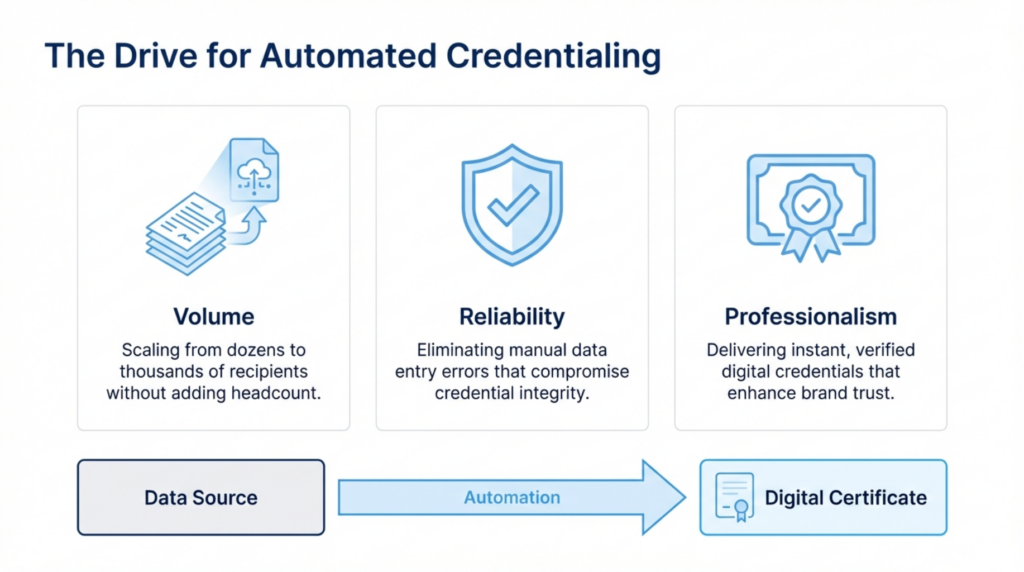
CertifyMe is used by organizations that require API-driven certificate automation integrated into training platforms, event systems, or custom-built applications. The platform is designed primarily for teams comfortable working with APIs, webhooks, and developer-centric workflows.
Automation is the foundation of CertifyMe’s value proposition. Organizations connect their LMS, event platforms, or internal systems to CertifyMe’s API infrastructure. When completion events occur, certificates are generated and distributed automatically using predefined templates and mapped data fields.
This model removes the need for manual certificate creation. Developers configure webhook endpoints that receive completion data and trigger certificate generation through API calls. CertifyMe works particularly well for teams embedding certificates directly into product experiences or managing technically complex learning ecosystems.
Typical users include EdTech platforms, SaaS products offering certifications, corporate training teams with engineering support, and event technology providers issuing certificates at scale. These users value automation speed and programmatic control over administrative simplicity.
Organizations without consistent access to developer resources often start exploring CertifyMe alternatives that deliver similar automation benefits with lower operational complexity.
Limitations of CertifyMe
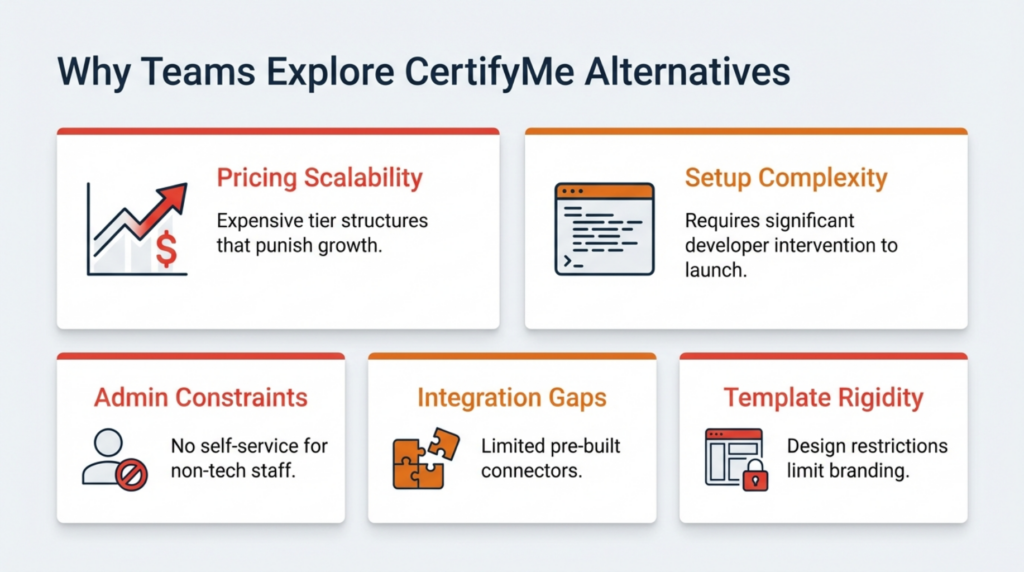
Organizations assessing other solutions often identify several constraints that become more apparent as certificate programs grow.
Pricing at scale is a frequent concern. CertifyMe’s volume-based pricing can rise quickly for organizations issuing thousands of certificates each month. Forecasting costs becomes difficult when issuance volumes fluctuate, which encourages teams to research CertifyMe alternatives with clearer and more predictable pricing structures.
Setup and maintenance complexity also impacts long-term usability. Initial configuration involves API authentication, webhook setup, template mapping, and thorough testing. Ongoing changes such as updating templates or modifying workflows typically require developer involvement, slowing down routine operations.
Limited accessibility for non-technical teams creates friction in day-to-day management. Administrators may struggle to update certificate designs, troubleshoot delivery issues, or adjust automation rules without engineering support. Many CertifyMe alternatives address this gap by offering self-service administrative tools.
Integration effort increases when organizations rely on platforms without native connectors. Although APIs allow custom integrations, building and maintaining them consumes developer time. Several alternatives emphasize simpler integrations or broader native ecosystem support.
Customization constraints can be an issue for branding-focused organizations that need frequent design updates or dynamic layouts. Teams with evolving branding requirements often prefer more flexible design engines.
These limitations do not reduce CertifyMe’s value for highly technical teams, but they clearly explain why organizations with different resource profiles seek CertifyMe alternatives.
What to Look for in CertifyMe Alternatives
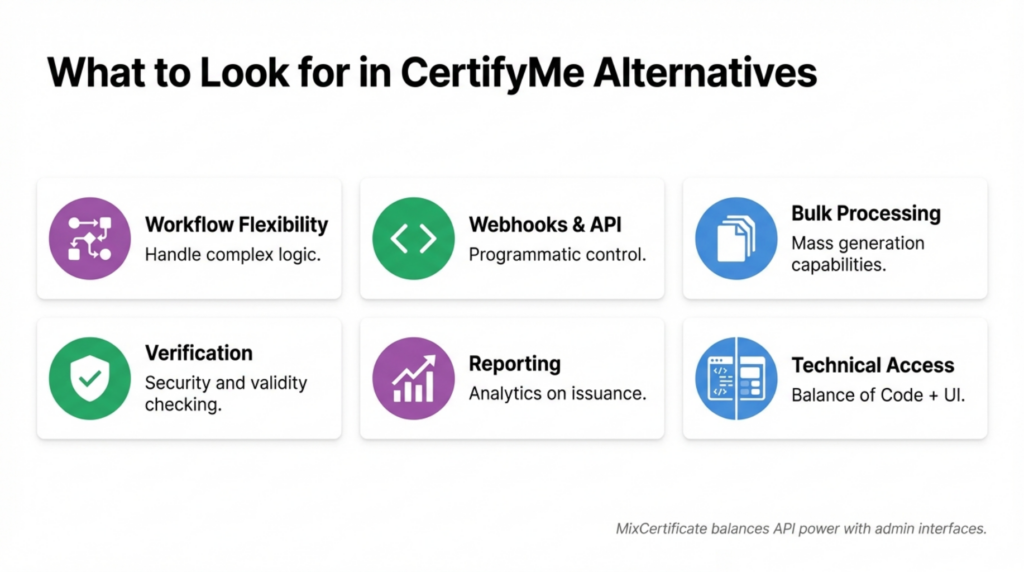
Evaluating platforms effectively requires focusing on features that directly impact scalability, efficiency, and operational independence.
Workflow flexibility plays a major role. Strong CertifyMe alternatives support conditional logic, scheduled issuance, approval steps, and workflow adjustments that non-technical users can manage independently. Platforms like MixCertificate enable both developers and administrators to modify workflows without heavy technical effort.
API and webhook quality remains critical for integration-heavy environments. Leading alternatives offer REST APIs, clear documentation, sandbox environments, and reliable webhook delivery. Well-documented APIs reduce implementation time and lower long-term maintenance costs.
Bulk processing reliability determines how well a platform performs during peak issuance periods. Effective alternatives handle large batches smoothly, include retry mechanisms for failed requests, and provide clear visibility into processing status.
Verification capabilities protect certificate authenticity and prevent fraud. Quality platforms offer QR code verification, unique certificate IDs, public verification portals, and tamper-resistant storage systems. Verification should be a standard feature rather than a paid add-on.
Reporting and analytics support compliance and optimization. Look for dashboards that show issuance trends, verification activity, and recipient engagement, along with export options for audits and internal reporting.
Technical accessibility should align with your team’s actual capabilities. Pure API tools maximize flexibility but require continuous developer involvement. Hybrid CertifyMe alternatives like MixCertificate balance API strength with admin-friendly interfaces, reducing long-term operational friction.
Top CertifyMe Alternatives Compared
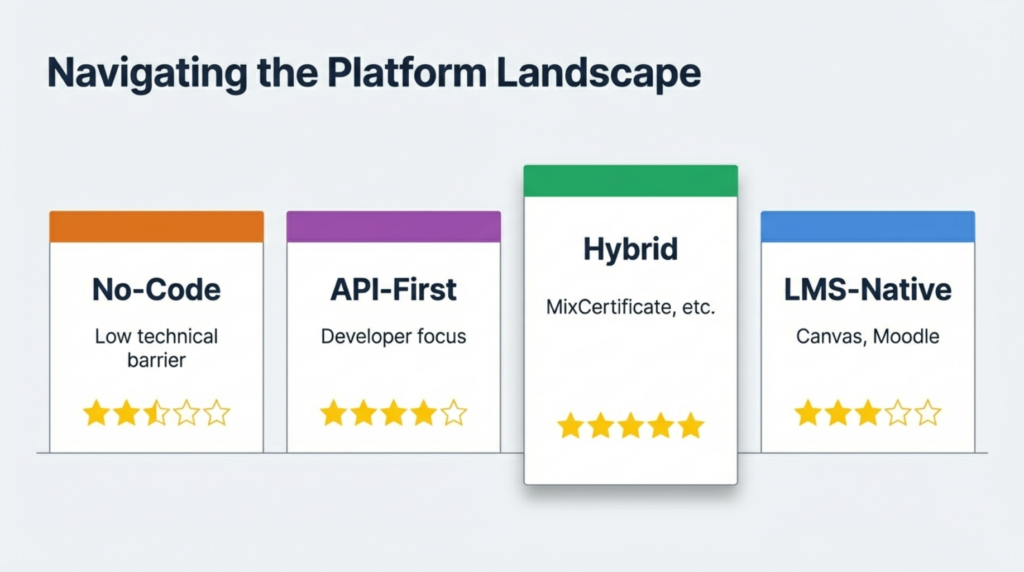
CertifyMe alternatives generally fall into several categories based on how they balance automation power and usability.
No-Code Certificate Platforms
No-code platforms prioritize ease of use and accessibility. They allow non-technical teams to automate certificate workflows using visual builders and form-based configuration. These tools work well for smaller teams but may lack advanced logic or deep customization.
API-First Certificate Tools
Developer-focused tools emphasize APIs and webhooks similar to CertifyMe. These CertifyMe alternatives suit engineering-heavy teams that want full programmatic control and are willing to manage technical complexity.
Hybrid Certificate Platforms
Hybrid platforms such as MixCertificate combine robust APIs with intuitive administrative interfaces. Developers manage initial integrations, while business users handle templates, workflows, and reporting. This model suits organizations that expect requirements to evolve over time.
LMS-Native Certificate Features
Some learning management systems include built-in certificate functionality. These solutions may serve as basic alternatives for education-focused organizations but typically lack advanced automation, verification depth, and cross-platform flexibility.
CertifyMe vs Flexible Certificate Software
Comparing CertifyMe with more flexible certificate platforms highlights key philosophical differences.
CertifyMe is developer-centric and assumes ongoing technical involvement. Many CertifyMe alternatives, particularly hybrid solutions, are admin-friendly and allow non-technical users to manage certificates after initial setup.
Scaling approaches also differ. CertifyMe scales technically through APIs but often requires developer input for operational changes. Flexible platforms scale both technically and operationally by enabling business users to manage routine updates.
Cost efficiency extends beyond subscription pricing. While CertifyMe’s platform fees may be competitive, the indirect cost of developer time can be significant. CertifyMe alternatives that reduce developer dependency often lower total cost of ownership.
Which CertifyMe Alternative Is Right for You?
Organizations with limited technical resources should prioritize CertifyMe alternatives offering strong administrative tools and minimal setup complexity.
Growing SaaS platforms benefit from hybrid solutions that support API integration while enabling operational self-service as programs mature.
High-volume certificate programs should evaluate alternatives with proven scalability, reliable bulk processing, and transparent pricing.
Integration-heavy workflows require platforms with well-documented APIs and dependable webhook infrastructure.
MixCertificate often aligns well with organizations seeking powerful automation without constant developer involvement.
Frequently Asked Questions
What are the best CertifyMe alternatives?
The best option depends on available technical resources and automation needs. Developer-heavy teams may prefer API-first tools, while organizations seeking operational simplicity often choose hybrid platforms.
Why do organizations switch from CertifyMe?
Common reasons include rising costs at scale, heavy developer dependency, limited admin control, and integration complexity.
Do alternatives to CertifyMe support APIs?
Yes. Most reputable platforms provide APIs, though documentation quality and ease of use vary.
Is MixCertificate a CertifyMe alternative?
Yes. MixCertificate serves organizations that want robust automation while reducing reliance on developers through a hybrid platform design.
Conclusion
CertifyMe effectively serves technically advanced teams that build certificate automation into complex systems. As programs scale, however, many organizations require greater operational flexibility, predictable pricing, and reduced dependence on engineering teams.
CertifyMe alternatives, particularly hybrid platforms like MixCertificate , offer a balanced approach by combining automation strength with administrative accessibility. Explore MixCertificate Pricing Plans for your Organizations evaluating options should carefully assess technical resources, automation complexity, and long-term operational needs to select a platform that aligns with real-world workflows rather than unused features.
