
Organizations requiring instant certificate delivery upon event completion need real-time automation exceeding capabilities of scheduled processing or manual workflows. Certificate software with webhooks enables event-driven certificate generation triggered immediately when actions occur in connected systems. Webhook-based automation eliminates delays between achievement completion and credential delivery, supporting time-sensitive scenarios where immediate certificate availability matters operationally.
Traditional workflows relying on scheduled synchronization create gaps between accomplishment and recognition. Certificate software with webhooks solves timing challenges through instant automated response to completion events. MixCertificate represents one platform supporting webhook-based automation, enabling organizations to implement real-time certificate workflows without extensive custom development.
Recent investigations highlight credential verification importance. India Today, fake degree operations demonstrate how fraudulent credentials undermine educational integrity globally. Similarly, The Australia Today reports connections between counterfeit qualifications and visa vulnerabilities. Furthermore, News.com.au exposes forgery operations profiting from bogus qualifications. These cases underscore why organizations need webhook-based platforms providing instant verification and tamper-proof tracking.
What Is Certificate Software with Webhooks?
Certificate software with webhooks connects credential platforms to external systems through event-driven HTTP callbacks. When specific events occur course completions, status updates, form submissions triggering applications send HTTP POST requests containing event data to certificate platform webhook endpoints. Platforms receive requests, process payload data, and execute configured actions automatically.
Webhooks differ from polling-based integration. Polling requires platforms to repeatedly query external systems checking for events, creating delays and server load. Webhooks receive instant notifications the moment events occur, enabling real-time response. This architectural difference makes webhook automation significantly more efficient.
Real-time events trigger certificate actions immediately upon occurrence. Student course completion triggers webhook notifications within seconds. MixCertificate processes completion data, generates personalized certificates, and delivers credentials before students navigate away from completion screens, supporting superior user experiences.
How Webhook-Based Certificate Workflows Operate ?
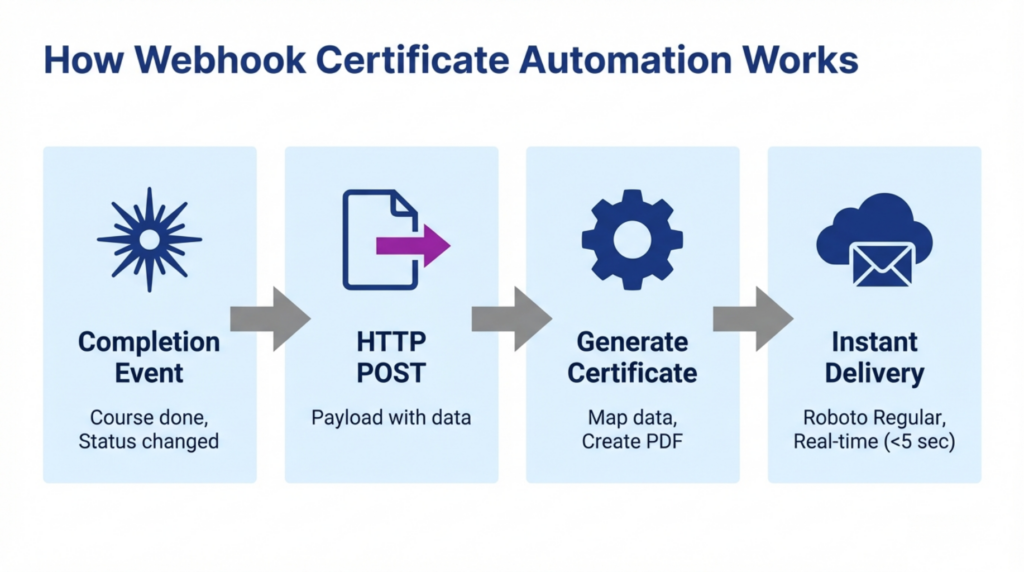
Workflows follow predictable patterns enabling reliable automated certificate generation.
Event Occurs: Workflows begin when configured events happen in connected systems. Learning platforms detect completions. HR systems register training completions. CRM tools update certification statuses. These triggering systems generate webhook notifications.
Webhook Payload Sent: Triggering systems send HTTP POST requests to certificate platform endpoints containing event data. Payloads include participant identification, achievement details, completion timestamps, and custom fields. MixCertificate webhook endpoints accept standardized JSON payloads enabling integration with diverse systems.
Processing Data: Upon receiving requests, platforms validate payload authenticity, extract relevant fields, and map information to certificate parameters. Authentication mechanisms verify sources preventing unauthorized generation. Data validation ensures payload completeness.
Certificate Generated and Delivered: After processing, platforms generate personalized certificates applying data to templates. Generation engines create PDF or image format certificates containing participant names, achievement descriptions, dates, and verification elements. Recipients receive certificates within seconds of triggering events.
Common Webhook Workflows for Certificate Software
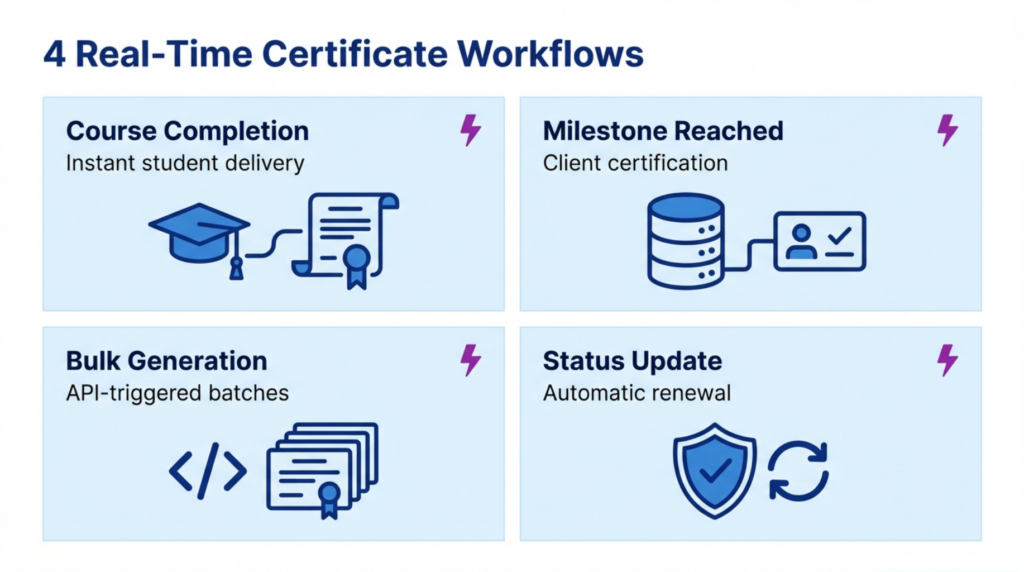
LMS Completion to Issuance: Learning management systems send completion notifications when students finish courses. Webhook payloads contain student identifiers, course names, completion timestamps, and grades. MixCertificate processes LMS webhooks supporting major learning platforms through standardized patterns. Students receive certificates automatically without instructor involvement.
CRM Milestone to Credentials: Customer relationship platforms tracking client certification progress trigger notifications when clients achieve milestones. Status updates generate webhook events. MixCertificate receives notifications, generates credentials, and delivers certificates to client contacts supporting sales and customer success teams.
Custom Application to Bulk Generation: Organizations developing custom training platforms integrate webhooks for automated credential generation. Custom applications send requests containing participant arrays when bulk generation becomes necessary. MixCertificate webhook endpoints accept bulk requests supporting high-volume scenarios through efficient batch processing.
Compliance Status to Renewal: Compliance systems monitoring regulatory requirements trigger notifications when professionals complete recertification activities. Status updates generate webhook events. MixCertificate receives notifications, generates updated certificates reflecting new expiration dates, and delivers renewed credentials automatically.
Certificate Automation Use Cases
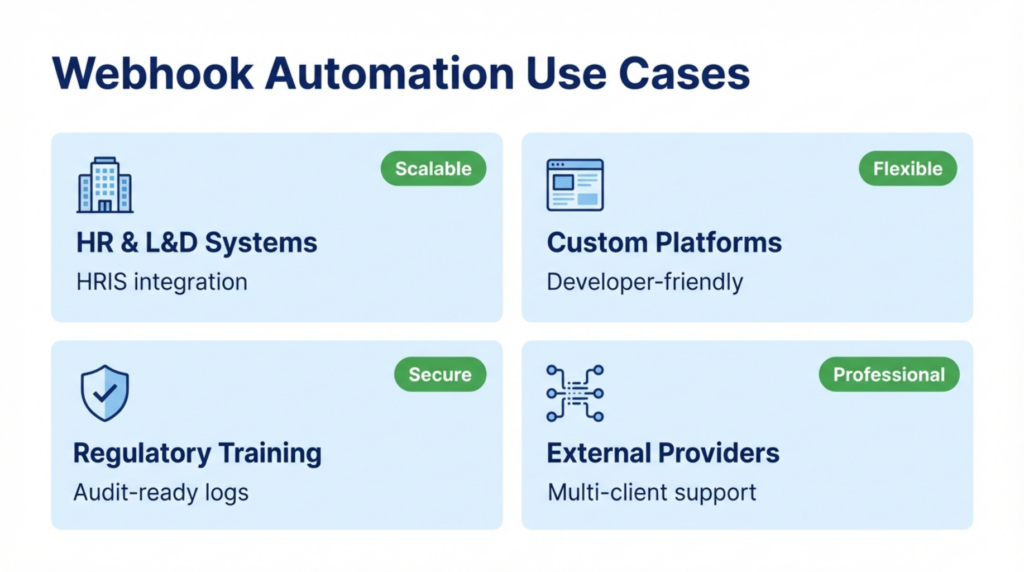
Enterprise HR & L&D Systems
Large organizations use webhooks to automate employee training certificates across enterprise systems. HR information systems and learning platforms trigger notifications when employees complete onboarding, compliance training, professional development, or skill certifications. MixCertificate integrates with enterprise technology stacks through webhook connections enabling automated distribution supporting workforce development.
Webhook automation scales across thousands of employees and hundreds of programs without requiring proportional administrative staffing. HR teams configure connections once, then certificates generate automatically as employees complete training.
Custom LMS Platforms
Educational institutions developing custom learning systems implement webhooks avoiding internal certificate infrastructure development. Custom platforms send notifications when students complete courses or programs. MixCertificate provides endpoints accepting diverse payload formats enabling platform developers to integrate professional generation without building engines internally.
Compliance & Regulatory Training
Industries with mandatory requirements use webhooks to automate compliance certificates. Healthcare organizations, financial services firms, manufacturing companies, and government agencies integrate compliance systems with certificate platforms. Training completion triggers notifications generating certificates documenting regulatory fulfillment. MixCertificate supports compliance workflows providing audit-ready records and verification systems.
External Training Providers
Corporate training companies and certification bodies use webhooks to deliver client credentials. Training platforms trigger notifications when participants complete contracted programs. MixCertificate enables training providers to offer professional credential services through webhook automation supporting diverse client requirements.
Step-by-Step: Setting Up Certificate Software with Webhooks
Identify Triggering System: Determine which platforms will initiate generation. Evaluate whether systems support webhook notifications and document available event types. Verify payload formats and authentication requirements.
Configure Webhook Endpoint: Establish endpoint URLs where triggering systems will send notifications. MixCertificate offers configuration dashboards enabling non-developers to establish endpoints through guided interfaces without coding requirements.
Define Event Payload: Document webhook payload structure including field names, data types, and required elements. Map payload fields to certificate data requirements ensuring triggering systems provide necessary information.
Map Certificate Fields: Connect webhook payload fields to certificate template elements. Participant names map to recipient name positions. Achievement descriptions map to text content. Completion dates populate date fields.
Test Webhook Delivery: Execute test requests using sample payloads before activating production workflows. Verify platforms receive notifications successfully. Confirm certificates generate with correct data. MixCertificate provides testing tools enabling workflow validation before deployment.
Monitor Logs: After activation, monitor delivery logs tracking successful processing and identifying failures. Establish monitoring systems alerting administrators to errors. Configure retry mechanisms handling temporary network issues.
Benefits of Using Webhooks for Certificate Automation
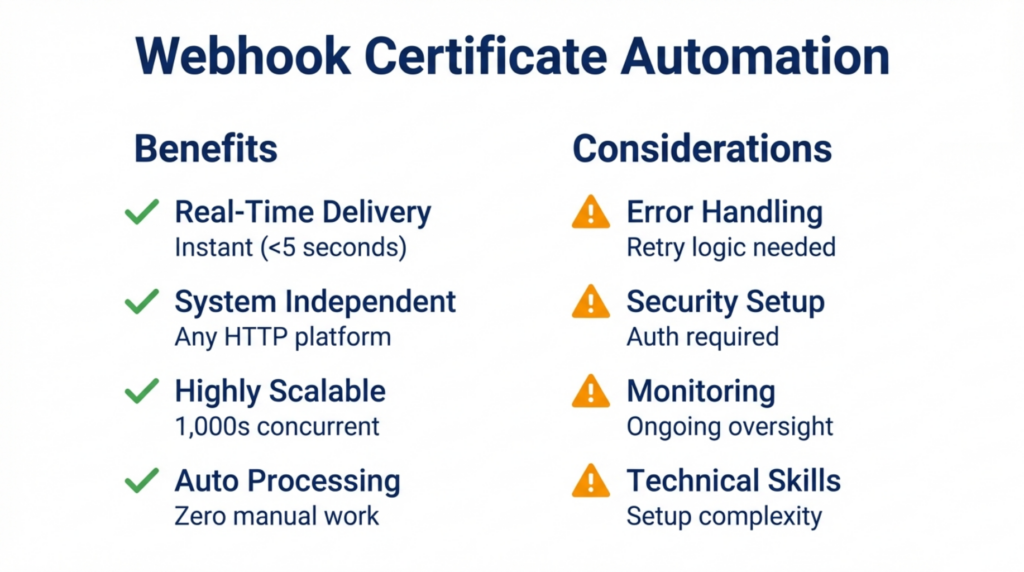
Real-Time Issuance: Webhook automation enables instant delivery upon event completion. Recipients receive credentials within seconds rather than waiting hours or days. Real-time issuance improves satisfaction and supports time-sensitive scenarios.
System Independence: Webhooks enable platforms to integrate with any system supporting HTTP callbacks regardless of vendor or technology. Organizations avoid vendor lock-in or platform limitations.
High Scalability: Webhook architecture scales efficiently handling increasing volumes without degradation. Platforms process individual requests independently enabling horizontal scaling.
Reduced Manual Intervention: Automated workflows eliminate manual generation, delivery, and tracking tasks. Operations teams configure workflows once then certificates generate automatically.
Custom Workflow Control: Organizations control exact conditions triggering generation through webhook configuration. Complex business logic determines when certificates generate providing flexibility matching requirements.
Limitations and Technical Considerations
Error Handling: Webhook delivery failures occur due to network issues, platform downtime, or configuration problems. Systems require robust error handling detecting failures and executing retry logic.
Security and Authentication: Webhook endpoints require authentication preventing unauthorized generation. Signature validation, API keys, or OAuth tokens verify source authenticity. MixCertificate provides multiple authentication options securing endpoints against unauthorized access.
Monitoring Requirements: Webhook workflows require ongoing monitoring ensuring continued operation. Organizations need dashboards showing delivery rates, success percentages, and error trends.
When Alternative Tools May Be Easier: Simple integration scenarios may benefit from no-code tools like Zapier rather than direct webhook implementation. Organizations lacking technical resources should evaluate whether webhook complexity exceeds capabilities.
Certificate Software That Supports Webhooks
API Stability: Platforms must maintain stable webhook APIs avoiding breaking changes. Evaluate vendor versioning practices, deprecation policies, and compatibility commitments.
Documentation Quality: Comprehensive documentation covering payload formats, authentication requirements, and examples enables successful integration. MixCertificate provides excellent documentation reducing integration friction.
Webhook Event Coverage: Platforms should support diverse events matching workflow requirements. Generation, delivery confirmation, verification events, and error notifications enable comprehensive automation.
Reporting and Logs: Detailed delivery logs and analytics dashboards enable troubleshooting and monitoring. MixCertificate offers comprehensive logging enabling operations teams to monitor integration health.
Pros and Cons of Certificate Software with Webhooks
Advantages:
- Real-time delivery within seconds
- System-agnostic integration
- Highly scalable architecture
- Elimination of manual tasks
- Full workflow customization
- Efficient processing avoiding polling
- Support for complex conditional logic
- Direct integration reducing dependencies
Limitations:
- Technical implementation complexity
- Error handling requiring monitoring
- Security configuration necessitating authentication
- Troubleshooting difficulties
- Network dependency vulnerabilities
- Maintenance requirements
- Learning curve for unfamiliar teams
Frequently Asked Questions
What is certificate software with webhooks?
Certificate software with webhooks enables event-driven generation through HTTP callbacks from external systems. When events occur—course completions, status updates—systems send webhook notifications triggering automatic generation and delivery. This architecture enables real-time issuance without polling delays supporting instant credential distribution.
How do webhooks automate certificate issuance?
Webhooks automate issuance by sending immediate notifications when triggering events occur. Platforms receive HTTP POST requests containing event data, process payload information, generate personalized certificates, and deliver credentials automatically. This approach eliminates delays enabling real-time distribution.
Are webhooks better than Zapier for certificates?
Webhooks provide greater customization and real-time responsiveness compared to Zapier but require more technical implementation. Webhooks enable direct integration without middleware, supporting millisecond-level response times. Zapier offers easier setup for standard workflows. Organizations with technical resources benefit from webhooks while those prioritizing simplicity may prefer Zapier.
Is certificate software with webhooks scalable?
Yes, webhook systems scale efficiently handling increasing volumes through independent request processing. MixCertificate supports thousands of concurrent webhook deliveries enabling organizations to process high volumes during peak periods. Horizontal scaling ensures consistent performance supporting business expansion.
Do HR teams need developers to use webhooks?
Webhook implementation typically requires technical resources for initial setup including endpoint configuration, authentication, and field mapping. MixCertificate provides guided interfaces reducing complexity but some technical expertise remains beneficial. After setup, HR teams operate workflows without ongoing developer involvement.
Does MixCertificate support webhook automation?
Yes, MixCertificate provides comprehensive webhook integration enabling real-time automation triggered by external system events. The platform offers endpoint configuration, flexible payload processing, authentication options, delivery logging, and error monitoring supporting enterprise-grade webhook workflows serving organizations requiring sophisticated automation.
Conclusion
Certificate software with webhooks enables real-time event-driven credential generation transforming delayed processing into instant automated delivery. Webhook architecture eliminates delays between achievement completion and credential provision supporting superior experiences and operational efficiency.
Understanding workflow structures, integration patterns, implementation steps, and operational considerations enables organizations to evaluate whether webhooks match technical capabilities and requirements.Explore MixCertificate Pricing Plans for your organization and Benefits including real-time issuance, system independence, scalability, and customization justify implementation investment for organizations with technical resources.
MixCertificate offers robust webhook integration supporting diverse automation workflows through flexible configuration, comprehensive event coverage, and operational monitoring tools. Organizations should evaluate platforms assessing API stability, documentation quality, and reporting capabilities. Successful implementations deliver efficiency gains, improved satisfaction, and scalable credential management while providing verification capabilities needed to combat credential fraud as highlighted in recent global investigations.
