
Introduction
Many course creators, trainers, and event organizers begin their certificate journey with Canva because it offers easy-to-use design tools and visually appealing certificate templates that require no technical knowledge. Canva works well for early-stage creators who issue certificates occasionally and prioritize aesthetics over operational efficiency.
However, as programs scale and certificate volumes increase, Canva quickly reveals its limitations. At that point, users actively search for Canva certificate alternatives that support automation, bulk generation, centralized tracking, and certificate verification. Common triggers include hours wasted on manual personalization, formatting inconsistencies across batches, inability to track recipients, and the complete absence of systems that verify certificate authenticity.
This guide explores Canva certificate alternatives designed for creators and organizations that need structured, automated certificate workflows rather than manual design files. Understanding these options helps teams move from time-consuming certificate creation to reliable automation while still maintaining professional visual quality.
Why Canva Is Not a Certificate Tool
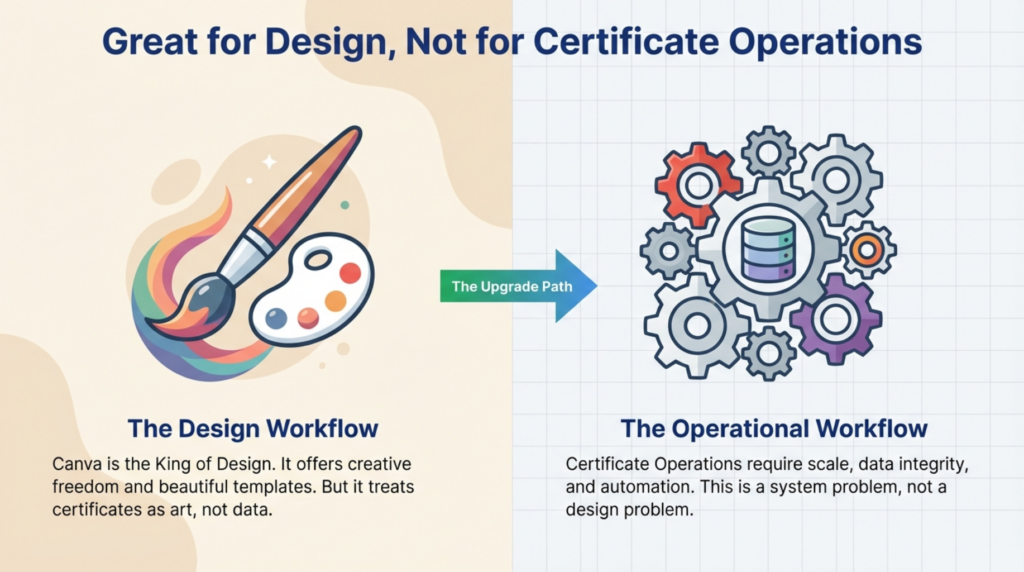
Canva is fundamentally a graphic design platform, not a credential management system. While it excels at visual creativity, it lacks the operational features required for professional certificate programs.
Canva treats certificates as static image or PDF files rather than credentials connected to data, workflows, or verification systems. It offers templates, but no native way to manage recipient records, track issuance history, or automate generation at scale.
Automation is effectively absent. Even Canva’s bulk creation feature still requires CSV uploads, manual field matching, file downloads, and separate email distribution. Each certificate cycle involves repetitive steps that become unsustainable as volumes increase.
Operational friction also appears during distribution. After certificates are created, users must manually download files and upload them to email tools, LMS platforms, or cloud storage. Every issuance round repeats this workflow, increasing the chance of errors.
Most critically, Canva provides no verification, tracking, or audit trail. Certificates have no unique IDs, QR codes, or public verification links. Files can be edited or reused without detection, leaving organizations unable to confirm authenticity.
These limitations explain why growing programs eventually replace Canva with Canva certificate alternatives built for automation rather than design alone.
Manual Certificate Pain Points with Canva
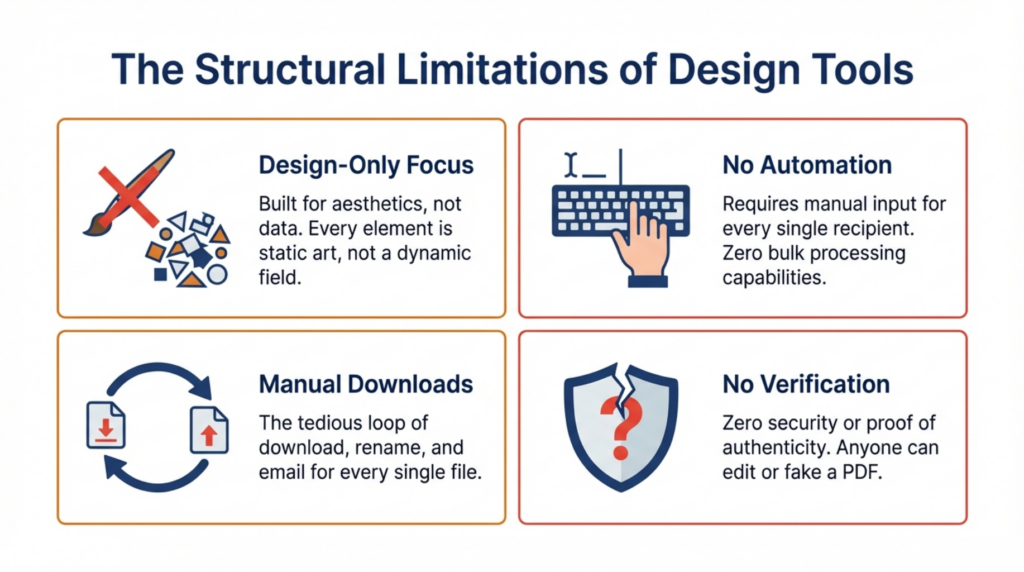
Organizations relying on Canva for certificates face predictable challenges that intensify with scale.
Manual personalization introduces frequent copy-paste errors. Names, dates, and credential details are often mistyped or misaligned. Even with careful review, mistakes slip through and damage professional credibility.
Formatting inconsistencies emerge when multiple team members edit templates or when certificates are updated over time. Fonts shift, spacing changes, and alignment varies between batches. Manual quality control cannot guarantee uniformity across hundreds of files.
Time costs grow exponentially. Creating 20 certificates might be manageable. Creating 200 can take days. Repeating the process monthly compounds inefficiency and diverts resources away from program growth.
Lack of records creates compliance risks. Canva provides no searchable history showing who received certificates, when they were issued, or which version was sent. Replacement requests, audits, and verification checks become manual investigations.
These challenges consistently push organizations toward Canva certificate alternatives that remove human error through automation.
What to Look for in Canva Certificate Alternatives
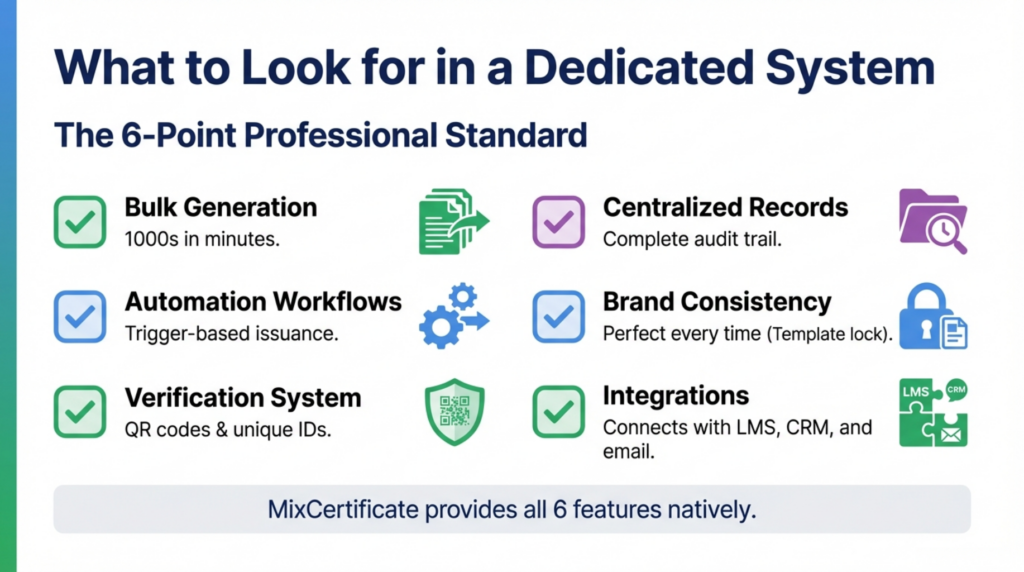
Choosing the right alternative requires focusing on operational capabilities rather than design features alone.
Bulk certificate generation should allow hundreds or thousands of certificates to be created automatically from spreadsheets, LMS platforms, or databases. Platforms like MixCertificate generate certificates for entire cohorts in minutes with no manual editing.
Automation workflows eliminate repetitive tasks. Strong Canva certificate alternatives trigger certificate creation automatically when learners complete courses, attendees finish events, or employees pass assessments. MixCertificate offers no-code automation accessible to non-technical users.
Verification systems are essential for credibility. Unlike Canva files, automated certificates include unique IDs, QR codes, or verification URLs. Employers or institutions can confirm authenticity instantly through public verification portals.
Centralized record management maintains complete issuance history. Quality platforms store recipient data, certificate versions, issuance dates, and verification activity in searchable dashboards. MixCertificate provides reporting suitable for compliance and audits.
Brand consistency ensures visual uniformity. Automated platforms apply templates consistently across all certificates, maintaining exact branding standards without manual checks.
Integrations and APIs connect certificates to existing tools such as LMS platforms, CRM systems, email services, and event software. This eliminates data duplication and manual uploads.
Organizations evaluating Canva certificate alternatives should prioritize automation depth that aligns with their certificate volume and issuance frequency.
Top Canva Certificate Alternatives Compared
Several categories of tools replace Canva depending on use case and technical capacity.
Dedicated Certificate Software
Purpose-built certificate platforms focus entirely on issuance, verification, and management. These Canva certificate alternatives provide bulk automation, built-in verification, reporting, and integrations.
MixCertificate represents this category by combining professional design quality with automation, verification, and workflow control that Canva lacks.
Automation-First Tools
Workflow automation platforms can generate certificates through integrations. These tools suit technical teams but often require complex setup and ongoing maintenance compared to dedicated platforms.
LMS-Integrated Certificates
Learning platforms like Moodle, Teachable, and Thinkific include certificate features tied to course completion. While convenient, they often lack advanced verification, customization, and cross-platform flexibility found in dedicated Canva certificate alternatives.
Event Platform Certificates
Event tools such as Eventbrite or Zoom Events offer basic certificates for attendees. These work for one-off events but are limited outside event-specific use cases.
Selecting the right alternative depends on certificate volume, verification needs, and operational complexity.
Canva vs Automated Certificate Software
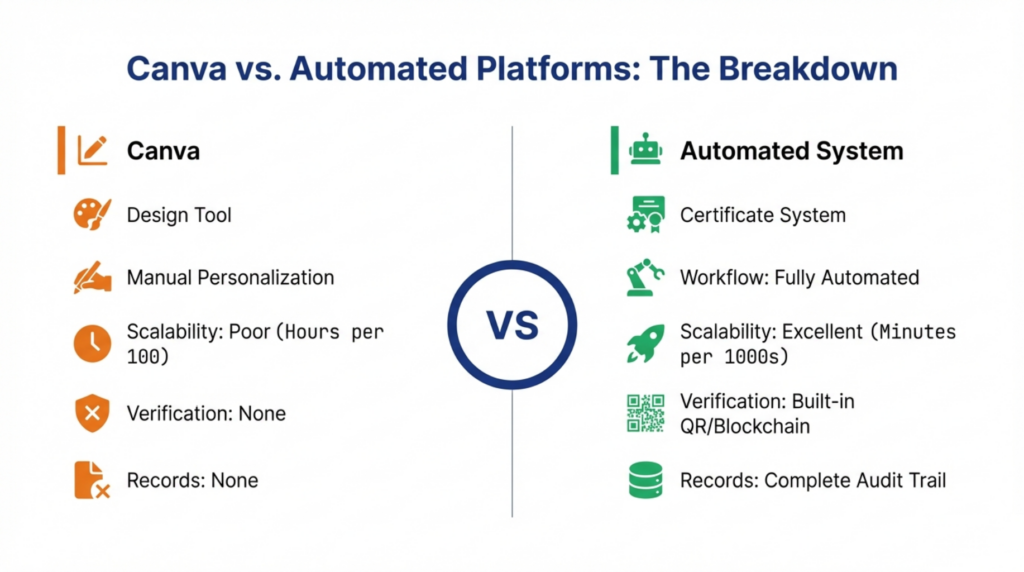
Canva and automated certificate systems serve different purposes.
Canva is a design tool optimized for creative flexibility. Automated platforms treat certificates as structured credentials requiring data, verification, and lifecycle management.
Scalability highlights the difference. Canva requires manual effort regardless of volume. Automated platforms generate certificates programmatically, making large-scale issuance effortless.
Time investment also differs sharply. Creating 100 certificates in Canva can take several hours of manual work. Platforms like MixCertificate generate the same volume in minutes once templates are configured.
For small, infrequent needs, Canva may suffice. For recurring or large-scale programs, Canva certificate alternatives become essential infrastructure rather than optional upgrades.
When Should You Move Away from Canva?
Certain signals indicate it is time to migrate.
If you regularly issue certificates to more than 20 to 30 recipients, manual workflows begin consuming excessive time.
Programs issuing certificates weekly or monthly benefit immediately from automation.
Any requirement for verification, compliance, or audit trails makes Canva unsuitable.
Strict brand consistency demands automated template enforcement.
Integration needs with LMS, HR, or event platforms require systems that Canva cannot support.
When these conditions apply, Canva certificate alternatives are no longer optional improvements but operational necessities.
Frequently Asked Questions (FAQs)
What are Canva certificate alternatives?
Canva certificate alternatives are automated platforms designed specifically for certificate generation, verification, and management at scale. Unlike Canva, which is a general design tool, these alternatives like MixCertificate provide bulk generation from recipient data, verification systems proving authenticity, automated distribution workflows, centralized record-keeping, and integration with learning or event platforms. They optimize for operational efficiency rather than design flexibility.
Why is Canva not suitable for certificates?
Canva lacks automation, bulk processing, verification, and record-keeping capabilities essential for professional certificate programs. Users must manually personalize each certificate, download files individually, distribute through separate tools, and have no verification system or audit trail. While Canva works for occasional certificates, it becomes time-prohibitive and operationally inadequate as volumes increase or verification requirements emerge.
Can Canva generate certificates in bulk?
Canva offers bulk creation features requiring CSV uploads and manual field mapping, but the process remains fundamentally manual. Users still download files individually or in batches, manually distribute certificates, and lack automation, verification, or tracking. True bulk generation as provided by Canva certificate alternatives like MixCertificate involves automatic personalization, generation, distribution, and verification without manual intervention for each batch.
Are automated certificate tools better than Canva?
Automated certificate tools excel for programs issuing certificates regularly or at scale, offering bulk generation, verification, audit trails, and workflow automation that Canva cannot provide. However, Canva remains suitable for occasional certificate needs prioritizing design experimentation over operational efficiency. The better choice depends on certificate volume, frequency, verification requirements, and available time for manual processes. Organizations issuing 50+ certificates monthly typically benefit from platforms like MixCertificate.
How do Canva certificate alternatives work?
Canva certificate alternatives automate certificate workflows by connecting to data sources containing recipient information. Organizations design certificate templates once, then the platform automatically generates personalized certificates from spreadsheets, learning management systems, or event platforms. Certificates include unique verification codes or QR links, get distributed automatically via email, and maintain centralized records. Platforms like MixCertificate eliminate manual personalization, downloading, and distribution through complete workflow automation.
Is MixCertificate a Canva certificate alternative?
MixCertificate serves as a comprehensive Canva certificate alternative for organizations outgrowing manual design workflows. While Canva focuses on design flexibility for occasional use, MixCertificate provides professional certificate templates with automation, bulk generation from data sources, verification systems, workflow integrations, and centralized management. Organizations find MixCertificate particularly valuable when certificate volumes exceed 30-50 monthly, verification is required, or time spent on manual Canva workflows becomes unsustainable. MixCertificate maintains design quality while adding operational capabilities Canva lacks.
Conclusion
Canva certificate alternatives solve operational problems that emerge once certificate programs scale beyond occasional manual creation. Canva remains useful for design experimentation, but it was never built to manage credentials at scale.
Organizations issuing certificates regularly benefit from platforms designed for automation, verification, and record-keeping. Canva certificate alternatives like MixCertificate demonstrate that professional design and powerful automation can coexist, enabling creators and Explore MixCertificate Pricing Plans for your organizations to issue certificates efficiently, securely, and at scale.
