
Organizations issuing hundreds or thousands of certificates monthly quickly discover that manual creation processes collapse under volume pressure. What begins as a simple task with 20 certificates becomes an operational nightmare at 200, consuming staff hours and introducing errors that damage credibility.
Bulk certificate generation tools solve this scaling problem by automating the entire workflow from data upload through customization to delivery. These specialized platforms process certificate batches in minutes rather than days, eliminating manual data entry while maintaining brand consistency across thousands of credentials.
This comparison examines how bulk certificate generation tools differ in speed, scalability, automation capabilities, and workflow integration. Understanding these functional differences helps training teams, HR departments, and educational institutions select platforms that match their volume requirements and operational workflows.
Overview of Bulk Certificate Generation Tools
Bulk certificate generation tools are specialized software platforms designed to create large quantities of personalized certificates from structured data sources. Unlike design tools that require individual manual creation, these systems process batches ranging from dozens to tens of thousands of certificates simultaneously.
The core problem these tools solve centers on scalability. Organizations need to issue certificates faster than manual processes allow while maintaining accuracy and professional appearance. Traditional approaches using PowerPoint templates or design software simply cannot keep pace with modern training program volumes.
Typical users include corporate HR departments managing employee training, educational institutions issuing graduation certificates, online course platforms serving thousands of learners, event organizers providing participation certificates, and professional certification bodies maintaining credential programs. MixCertificate serves these audiences as a dedicated bulk certificate platform designed specifically for high-volume credential workflows.
These platforms transform certificate creation from a time-intensive manual task into an automated workflow requiring minimal human intervention. The shift fundamentally changes how organizations approach credential management at scale.
Why Manual Certificate Creation Fails at Scale
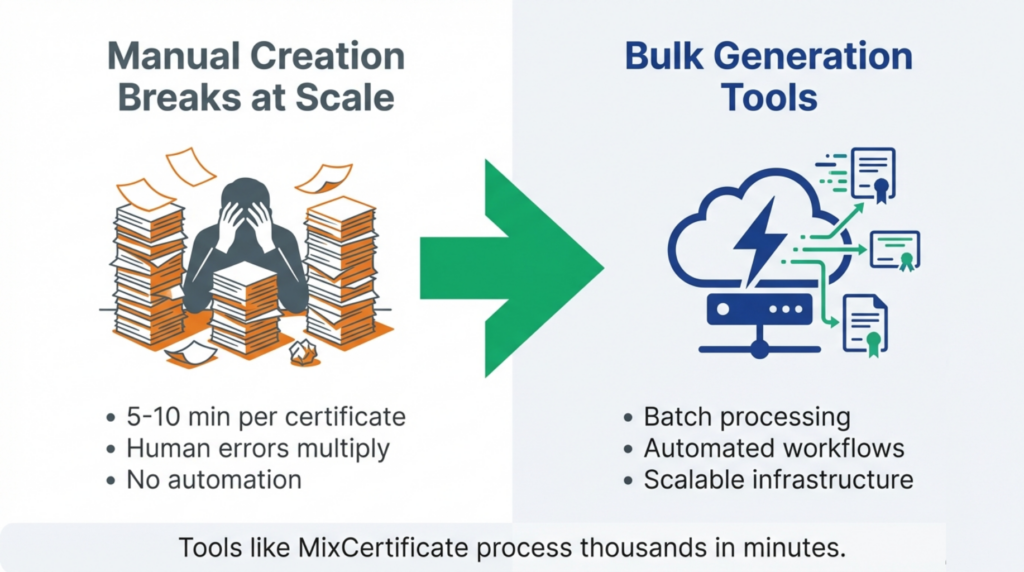
Manual certificate creation breaks down predictably as volume increases, creating operational bottlenecks that automated tools eliminate.
Time consumption becomes unsustainable quickly. Creating a single certificate manually takes 5 to 10 minutes including data entry, formatting verification, quality checking, and export. At 100 certificates monthly, this consumes 8 to 16 hours of staff time. At 500 certificates, the workload requires dedicated personnel doing nothing but certificate production.
Human errors multiply with volume. Manual data entry inevitably produces misspelled names, incorrect dates, wrong course titles, and formatting inconsistencies. Each error requires rework, further consuming time and frustrating certificate recipients who receive credentials with mistakes.
Formatting inconsistencies emerge when multiple people create certificates or when templates drift over time. Brand guidelines become impossible to enforce across hundreds of manually created certificates. Visual quality varies based on who created each certificate and when.
Tracking difficulties compound operational problems. Spreadsheets tracking who received which certificate when become unwieldy. Organizations lose visibility into issuance history, making it difficult to verify credentials or respond to verification requests. Compliance requirements for audit trails remain unsatisfied.
These systematic failures explain why organizations migrate to bulk certificate generation tools once volume exceeds approximately 50 certificates monthly. The transition point varies, but the pattern remains consistent across industries.
Tools Comparison: Speed, Scale & Accuracy
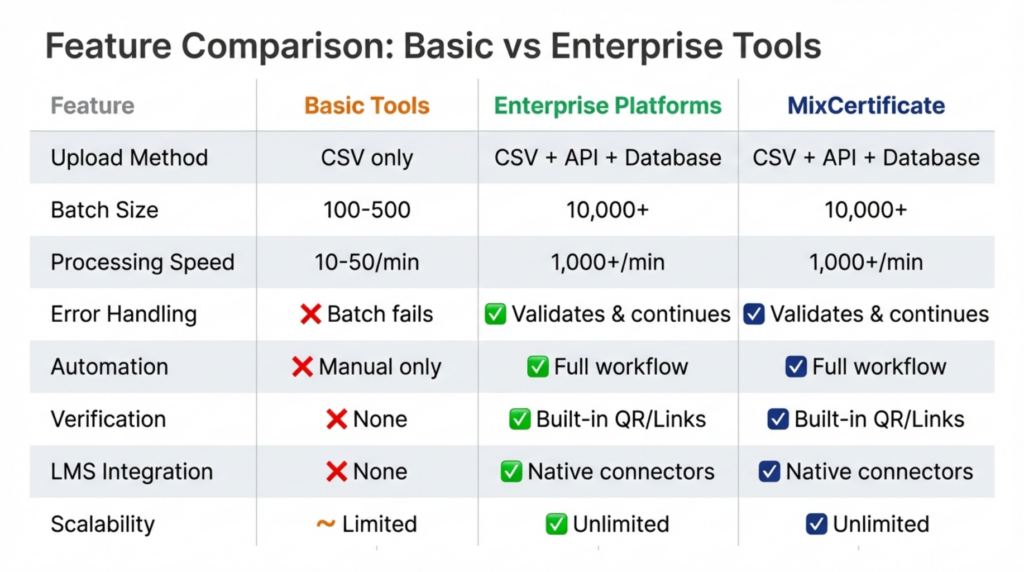
Bulk certificate generation tools differ significantly in their technical capabilities and operational characteristics. Understanding these differences helps organizations select platforms matching their specific requirements.
Data Upload Methods
Tools accept data through CSV file uploads, direct API integrations, or database connections. CSV uploads suit organizations with existing data in spreadsheets. API integrations enable real-time certificate generation triggered by learning management system completions or HR system events. Platforms like MixCertificate support multiple upload methods to accommodate diverse workflow requirements.
Batch Processing Capacity
Entry-level tools process 100 to 500 certificates per batch. Mid-tier platforms handle 1,000 to 5,000 certificates. Enterprise solutions like MixCertificate process tens of thousands of certificates in single batches without performance degradation. Capacity limits directly impact operational efficiency for high-volume programs.
Processing Speed
Speed varies dramatically across platforms. Some tools generate 10 certificates per minute while others process 1,000 per minute. Processing time depends on template complexity, verification features, and infrastructure quality. Organizations issuing certificates for time-sensitive events need platforms delivering batches within minutes rather than hours.
Error Handling
Robust platforms validate data before processing, flagging missing fields, invalid formats, or duplicate entries. Advanced error handling prevents batch failures, allowing partial processing of valid records while identifying problematic data for correction. This capability saves significant time compared to tools that fail entire batches over single data errors.
Customization Options
Template customization ranges from basic field replacement to dynamic layouts adjusting to variable data lengths. Professional platforms maintain brand consistency while accommodating diverse certificate types within the same system. The balance between flexibility and scalability separates enterprise tools from basic generators.
Verification Infrastructure
Leading bulk certificate generation tools embed unique verification codes or QR codes in each certificate, linking to databases that validate authenticity. This feature proves essential for credentials with compliance value or external recognition requirements. Design tools and basic generators lack verification capabilities entirely.
Export Formats
Standard outputs include PDF for distribution and printing. Advanced platforms generate web-based certificates, blockchain-anchored credentials, or API-accessible digital certificates. Export format flexibility determines how recipients can use and share their credentials.
Scalability Limits
Infrastructure determines ultimate scalability. Cloud-based platforms like MixCertificate scale dynamically with demand, handling sudden volume spikes without manual intervention. Self-hosted solutions hit hard limits based on server capacity, requiring infrastructure planning as certificate volumes grow.
Speed & Scalability Explained
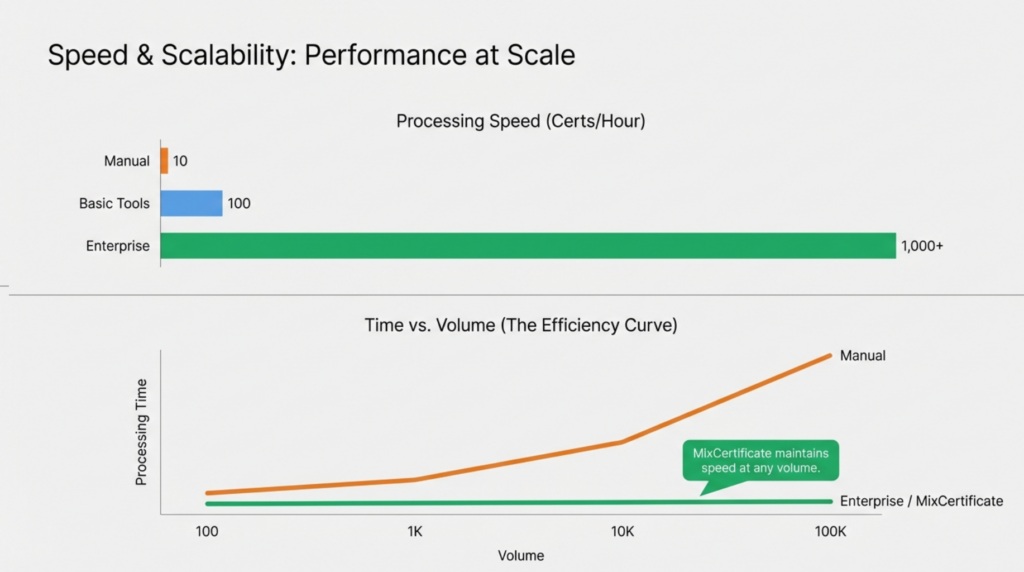
The technical architecture underlying bulk certificate generation tools determines their performance characteristics at scale.
Batch processing represents the fundamental efficiency gain over manual methods. Rather than creating certificates sequentially, batch processing generates hundreds or thousands simultaneously. This parallel processing reduces 10 hours of manual work to minutes of automated processing.
Performance under large datasets varies based on infrastructure quality. Well-designed platforms maintain consistent processing speed whether generating 100 or 10,000 certificates. Poorly architected tools slow dramatically as batch sizes increase, sometimes failing entirely with large datasets.
Infrastructure requirements differ significantly between cloud-based and self-hosted solutions. Cloud platforms like MixCertificate require no local infrastructure investment, scaling automatically with demand. Self-hosted tools require server capacity planning, database optimization, and bandwidth provisioning to handle peak loads.
Processing speed directly impacts operational flexibility. Organizations running time-sensitive programs need platforms delivering certificate batches within minutes of triggering events. Monthly batch processing tolerates slower speeds, but responsive systems reduce administrative burden and improve learner experience through faster credential delivery.
Scalability extends beyond raw processing speed to encompass reliability under varying loads, data handling efficiency, and infrastructure resilience. True scalability means maintaining performance and accuracy as volumes grow from hundreds to hundreds of thousands of certificates annually.
Automation & Workflow Integration
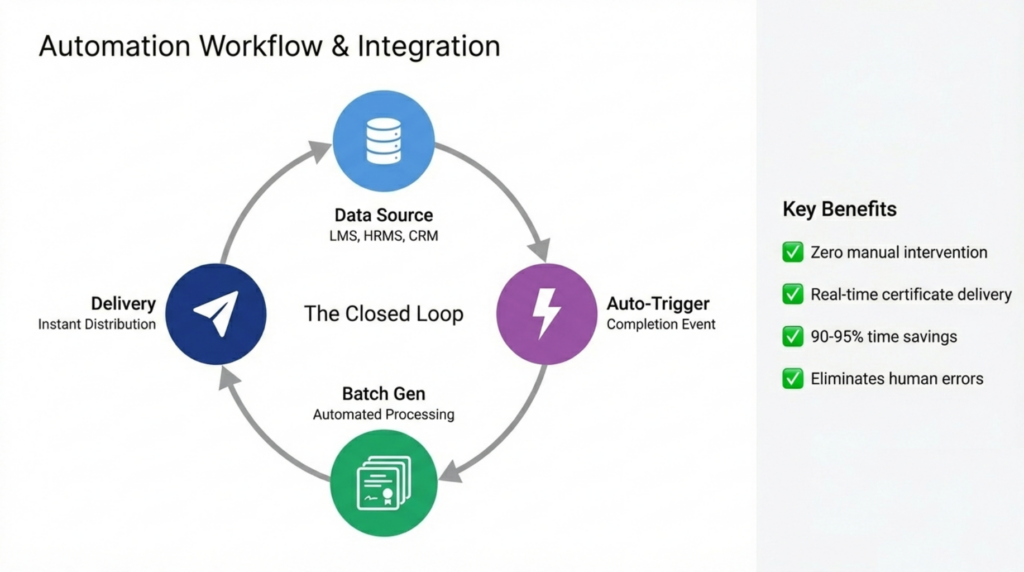
The most powerful aspect of bulk certificate generation tools lies in their ability to integrate with existing systems and automate entire credential workflows.
Automated data ingestion eliminates manual data preparation. Tools connecting directly to learning management systems, HR platforms, or CRM databases pull completion data automatically, removing the manual export-import cycle that introduces delays and errors. Real-time integration means certificates generate immediately upon course completion or training verification.
Trigger-based generation enables truly hands-off certificate workflows. When a learner completes a course, the LMS sends a completion event to the certificate platform, which generates and delivers the credential automatically. This automation reduces administrative workload while improving learner satisfaction through instant credential access.
Integration capabilities vary widely across platforms. Basic tools require manual CSV uploads for each batch. Intermediate platforms offer API access for custom integrations. Enterprise solutions like MixCertificate provide pre-built connectors for major learning management systems, HRMS platforms, and CRMs, plus flexible APIs for custom workflows.
Reduced operational workload represents the primary business value of automation. Organizations report 90 to 95 percent reductions in certificate-related staff time after implementing automated bulk generation tools. This efficiency gain frees training teams to focus on program improvement rather than credential production.
Automation transforms certificates from operational burden into strategic asset. When credential issuance requires no manual intervention, organizations can scale training programs without scaling administrative staff proportionally.
Common Use Cases for Bulk Certificate Generation
Specific organizational scenarios benefit particularly from bulk certificate generation capabilities.
Employee training programs in mid-sized and large organizations issue certificates for onboarding, compliance training, skill development, and professional development courses. These programs typically run monthly or quarterly batches ranging from 50 to 5,000 certificates depending on organization size. MixCertificate and similar platforms automate these recurring workflows.
Online courses serving external learners need scalable certificate delivery matching course completion patterns. Platforms hosting multiple courses with rolling enrollments might issue certificates continuously throughout the month. Bulk generation tools process these varied patterns efficiently.
University certifications for continuing education, professional development programs, and executive education courses require formal credentials meeting academic standards. Institutions issuing thousands of certificates per semester benefit from automated workflows that maintain quality while processing high volumes.
Event participation certificates for conferences, workshops, webinars, and professional gatherings often involve hundreds or thousands of attendees receiving credentials simultaneously after event completion. Bulk generation tools process entire attendee lists efficiently.
Compliance training in regulated industries requires documented proof of training completion with audit trails. Healthcare, finance, manufacturing, and other regulated sectors issue certificates as compliance evidence. Platforms like MixCertificate include verification and record-keeping features these use cases require.
Each scenario shares common requirements for speed, accuracy, brand consistency, and scalability that bulk generation tools address more effectively than manual processes.
What to Look for in Bulk Certificate Generation Tools
Evaluating bulk certificate generation platforms requires examining specific capabilities that determine operational effectiveness.
Speed directly impacts operational efficiency. Look for platforms processing at least 500 certificates in under 5 minutes. Faster processing enables responsive workflows and reduces delays between course completion and credential delivery.
Accuracy through data validation prevents errors before they reach certificates. Platforms should flag missing required fields, invalid data formats, and potential duplicates before processing batches. Error prevention saves significant rework time.
Data security proves essential when handling personally identifiable information. Platforms should encrypt data in transit and at rest, maintain SOC 2 compliance, and provide granular access controls. Security failures expose organizations to regulatory and reputational risks.
Custom branding enables professional credentials matching organizational identity. Look for template systems allowing complete design control while maintaining automation efficiency. The best platforms balance creative flexibility with operational scalability.
Verification support through unique codes, QR links, or blockchain anchoring prevents fraud and enables third-party validation. This capability proves essential for credentials with external recognition value or compliance requirements.
Reporting and exports provide visibility into certificate issuance patterns, recipient engagement, and verification requests. Analytics help optimize programs while satisfying audit requirements. Platforms like MixCertificate include comprehensive reporting dashboards.
Organizations should also evaluate integration capabilities, customer support quality, pricing models, and vendor stability when selecting bulk certificate generation tools.
Limitations of Design Tools for Bulk Certificates
General design tools like Canva, PowerPoint, or Adobe Illustrator lack features necessary for efficient bulk certificate generation.
No native batch processing means creating certificates individually or using mail merge features that remain clunky and error-prone. Even with templates, design tools require manual intervention for each certificate or complex workarounds that break at scale.
Manual workflow requirements prevent automation. Design tools cannot connect to learning management systems, pull data automatically, or trigger certificate generation based on completion events. Every certificate batch requires manual data preparation, template population, and individual exports.
No verification infrastructure leaves certificates vulnerable to fraud. Design tools produce static PDFs with no authentication mechanism. Anyone can duplicate or alter certificates, undermining credential value for programs requiring verification.
Limited tracking capabilities mean organizations must build separate systems for recording who received which certificate when. Design tools provide no audit trails, analytics, or verification databases that compliance programs require.
Scalability barriers emerge quickly. What works for 20 certificates breaks at 200. The linear relationship between effort and volume means design tools never achieve the efficiency gains that dedicated bulk certificate generation tools provide.
Organizations starting with design tools inevitably migrate to specialized platforms like MixCertificate once certificate volumes exceed approximately 50 monthly or when compliance requirements emerge. The transition costs less than continuing manual processes at scale.
FAQs: Bulk Certificate Generation Tools
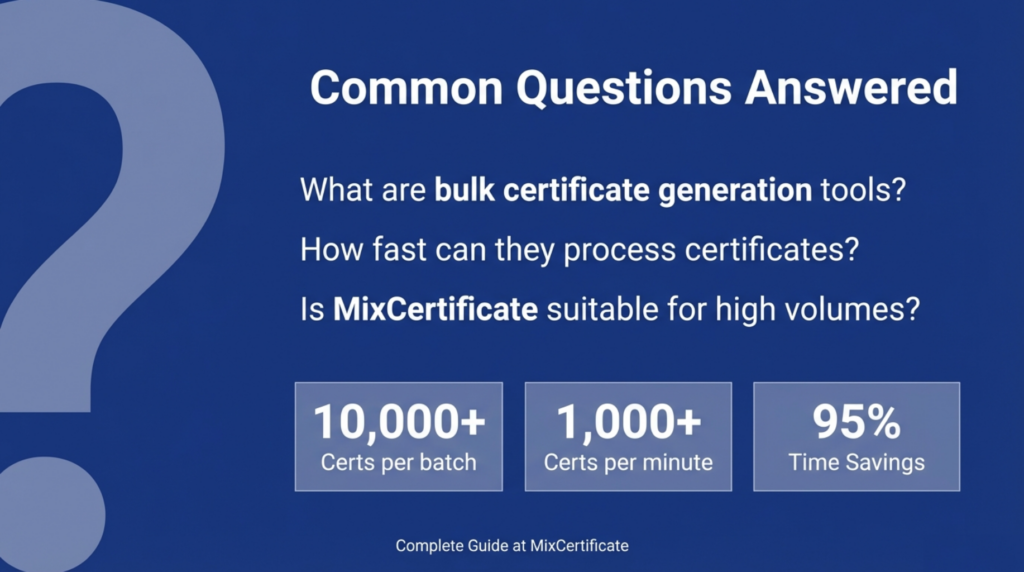
What are bulk certificate generation tools?
Bulk certificate generation tools are specialized software platforms designed to create large quantities of personalized certificates automatically from structured data sources. These systems process batches ranging from dozens to tens of thousands of certificates simultaneously, eliminating manual creation workflows while maintaining brand consistency and accuracy across high volumes.
How do bulk certificate generators work?
Bulk certificate generators accept data through CSV uploads, API integrations, or database connections containing recipient names, completion dates, course information, and other personalization fields. The platform applies this data to certificate templates, generates individual personalized certificates, and delivers them via email or download links. The entire process completes in minutes rather than hours or days.
Can bulk certificate generation be automated?
Yes, bulk certificate generation can be fully automated through API integrations with learning management systems, HR platforms, or CRM databases. When these systems detect course completions or training events, they trigger automatic certificate generation and delivery without manual intervention. Platforms like MixCertificate specialize in these automated workflows, reducing administrative workload by 90 to 95 percent.
Are bulk certificate generation tools secure?
Reputable bulk certificate generation tools implement enterprise-grade security including data encryption, SOC 2 compliance, access controls, and secure cloud infrastructure. Leading platforms like MixCertificate handle personally identifiable information according to privacy regulations while maintaining verification databases that prevent certificate fraud through unique authentication codes.
Who should use bulk certificate generation tools?
Organizations issuing more than 50 certificates monthly should consider bulk certificate generation tools. Primary users include HR and L&D teams managing employee training, educational institutions issuing academic credentials, online course platforms serving thousands of learners, event organizers providing participation certificates, and professional certification bodies. The crossover point occurs when manual processes consume more than 10 hours monthly.
Is MixCertificate suitable for bulk certificate generation?
MixCertificate is specifically designed for bulk certificate generation at enterprise scale. The platform processes tens of thousands of certificates per batch, integrates with major learning management systems and HR platforms, includes verification infrastructure, and provides comprehensive analytics. MixCertificate serves organizations requiring high-volume certificate workflows with automation, compliance features, and scalability that general design tools cannot provide.
Conclusion
Bulk certificate generation tools transform credential issuance from time-intensive manual processes into automated workflows that scale efficiently. Explore MixCertificate Pricing Plans for your Organizations moving beyond 50 certificates monthly discover that specialized platforms deliver speed, accuracy, and integration capabilities that design tools cannot match.
The comparison reveals clear differentiators across speed, scalability, automation, verification, and workflow integration. Platforms like MixCertificate address enterprise requirements through batch processing infrastructure, API integrations, and compliance features purpose-built for high-volume credential programs.
Selecting the right bulk certificate generation tool requires evaluating specific organizational needs against platform capabilities. Speed requirements, integration needs, verification features, and volume patterns determine which tools match operational workflows. Understanding these factors helps organizations implement solutions that eliminate manual bottlenecks while scaling efficiently.
