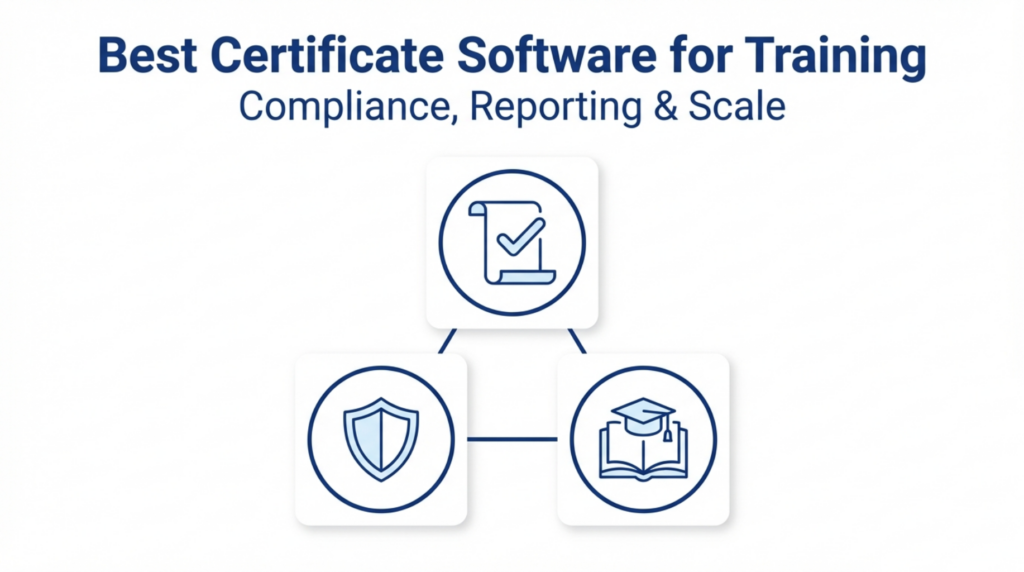
Corporate training programs issue certificates for compliance, skill validation, and employee development records. The best certificate software for training automates this process, replacing manual PDF creation with systems that generate, track, and verify certificates at scale while maintaining compliance audit trails.
Training teams face unique certification challenges. Compliance regulations require documented proof of training completion. Manual certificate creation delays record-keeping by weeks. Design tools like Canva lack compliance tracking features. LMS-generated certificates often fail portability and verification requirements. This guide compares certificate software solutions designed specifically for training program needs.
What Is Certificate Software for Training?
Certificate software for training is a digital platform that automates certificate creation, compliance tracking, and record management for employee training programs. Instead of manually designing individual certificates, training teams upload employee data and generate personalized certificates with built-in audit trails and verification.
Training teams use the best certificate software for training to document various program completions. Compliance certificates prove regulatory training completion for safety, harassment prevention, and industry-specific requirements. Skill certificates validate competency development in technical skills, software proficiency, or professional capabilities. Onboarding certificates document new employee training completion.
The fundamental difference between manual and automated approaches lies in compliance documentation and scalability. Manual methods create certificates without systematic tracking, making audit preparation difficult. The best certificate software for training maintains comprehensive records linking certificates to training dates, instructors, and renewal requirements automatically.
Why Training Teams Need Dedicated Certificate Software ?
Training programs operate under regulatory compliance requirements. OSHA safety training, harassment prevention, financial services regulations, and healthcare certifications all mandate documented training completion. Missing or inadequate records result in compliance violations, fines, and legal liability.
Compliance requirements demand systematic record-keeping. Regulators expect complete training histories showing who completed which training, when completion occurred, who provided instruction, and when renewal becomes necessary. Manual spreadsheets and folder-based filing systems fail to provide this level of documentation reliably.
Audit readiness determines organizational risk exposure. During compliance audits, regulators request comprehensive training records covering multiple years. The best certificate software for training provides instant access to complete training histories, searchable by employee, program, or date range, reducing audit preparation from weeks to hours.
Time savings become substantial at organizational scale. Generating 200 employee certificates manually requires 26 to 40 hours of work. Certificate software for training reduces this to 30 minutes, freeing HR and L&D staff for program development rather than administrative tasks.
Automation benefits extend beyond initial certificate generation. Expiration tracking automatically identifies employees requiring renewal training. Batch regeneration handles annual recertification for entire departments simultaneously. Integration with learning management systems triggers certificate generation upon course completion without manual intervention.
Reduced administrative workload allows training teams to focus on program quality rather than paperwork. Certificate management often consumes 20 to 30 percent of training administrator time in organizations relying on manual processes. Automation reclaims this time for strategic training initiatives.
Certificate Compliance & Record-Keeping for Training
Regulatory requirements vary by industry but consistently demand verifiable training records. Healthcare organizations must document HIPAA training, infection control, and patient safety certifications. Manufacturing facilities require documented safety training, equipment operation certifications, and hazardous materials handling credentials.
Employee training history serves multiple purposes beyond compliance. Performance reviews reference skill development progress. Promotion decisions consider professional development completion. Career pathing identifies skill gaps requiring targeted training interventions.
Renewal and expiration tracking prevents compliance lapses. Many certifications expire annually or biannually, requiring systematic monitoring. The best certificate software for training automatically flags upcoming expirations, triggers renewal notifications, and generates compliance reports showing renewal status across the organization.
Audit preparation requires producing comprehensive documentation quickly. Auditors typically request records spanning three to seven years. Manual systems require hours of file searching and spreadsheet compilation. Certificate software provides instant filtered exports showing exactly what auditors request, complete with verification trails confirming certificate authenticity.
According to OSHA training requirements, documented training records are essential for workplace safety compliance.
Reporting & Analytics for Training Certificates
Training effectiveness depends on measuring completion rates, identifying gaps, and demonstrating ROI. HR departments need quantifiable data showing training program participation and completion across departments, locations, and job roles.
Completion tracking answers critical questions. What percentage of employees completed required safety training? Which departments show lower completion rates requiring intervention? How does completion timing align with training deadlines? These insights drive program improvements and identify compliance risks before they become violations.
Exportable records support various organizational needs. HR information systems require training data for employee records. Compliance reports demand aggregated completion statistics. Budget planning uses historical data to forecast training program costs and resource requirements.
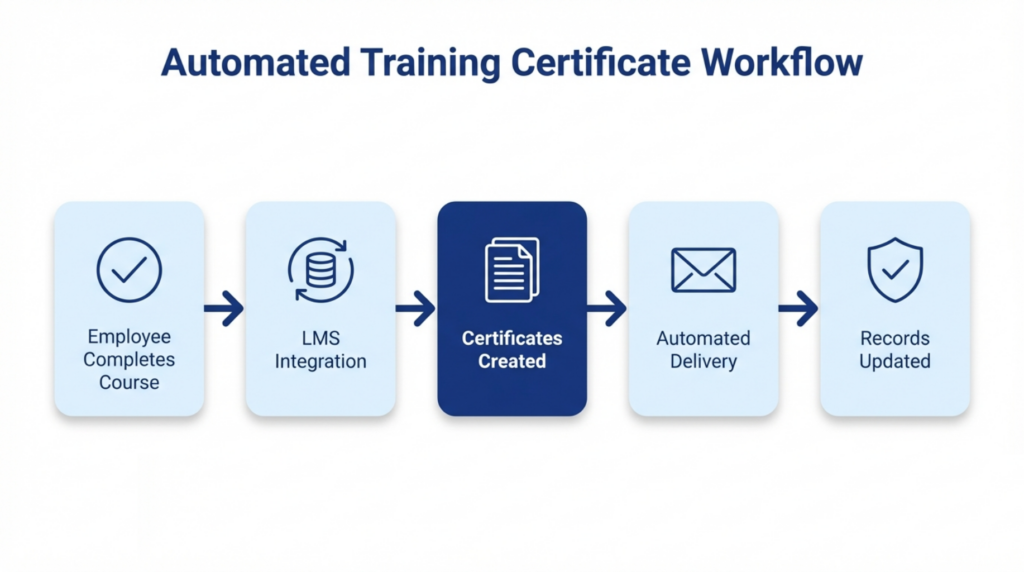
Integration with HR and LMS systems eliminates duplicate data entry and ensures record synchronization. When employees complete LMS courses, certificate software automatically generates credentials and updates training records. HR systems receive completion notifications maintaining employee file accuracy without manual updates.
SHRM research shows that training analytics improve program effectiveness.
Common Certificate Methods Used in Training Programs
Design Tools (Canva, PowerPoint)
Training teams often start with Canva or PowerPoint for certificate creation. These tools allow custom branding and design flexibility matching corporate identity guidelines.
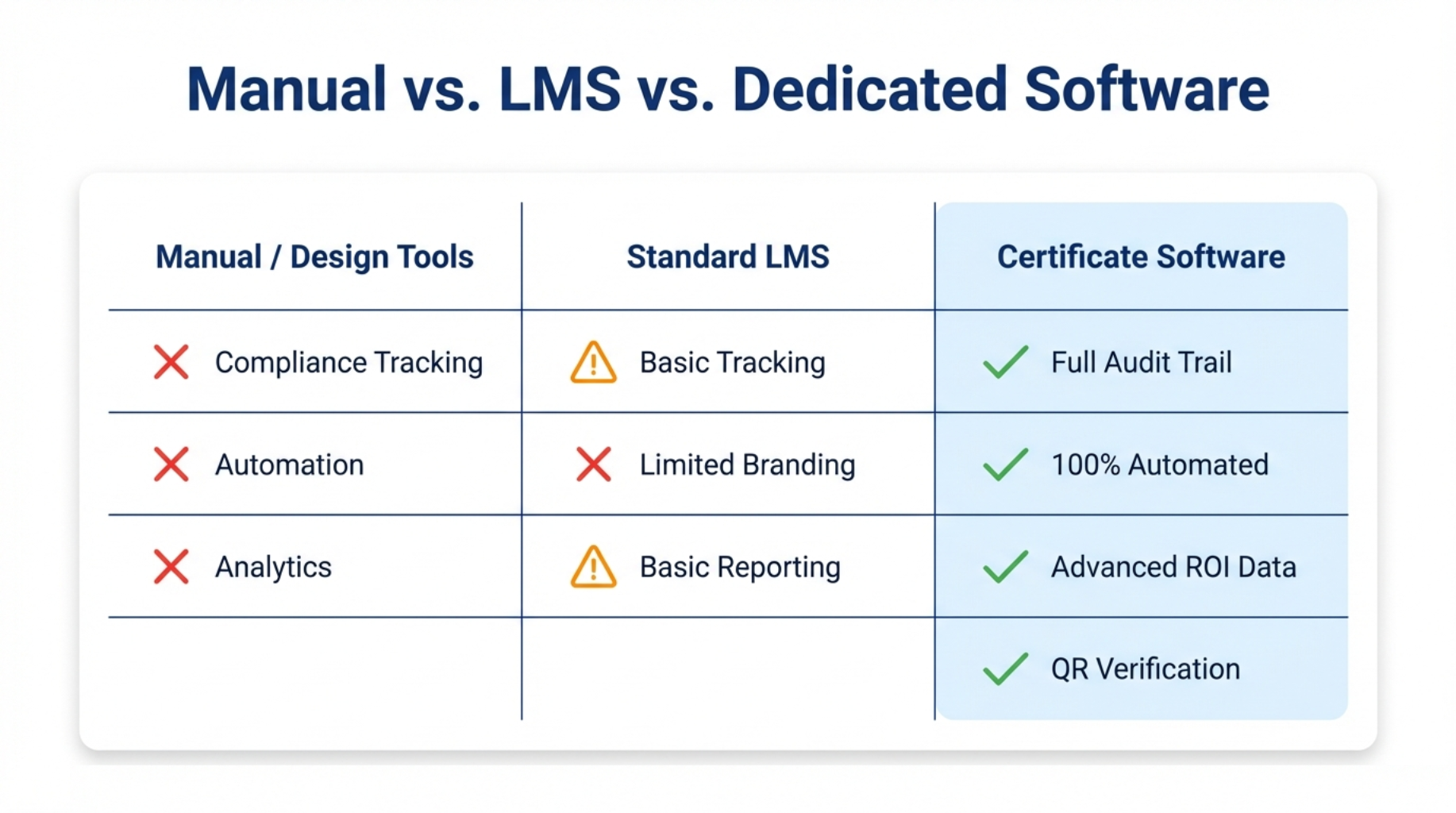
However, they fail compliance needs entirely. No systematic tracking links certificates to training dates or completion records. No expiration monitoring identifies renewal requirements. Audit preparation requires manual file searching through folders of individual certificate files.
Additionally, verification becomes impossible. When regulators question certificate authenticity, design tool certificates provide no verification mechanism. Manual phone calls to training departments become the only confirmation method, creating administrative burden that scales poorly.
LMS-Generated Certificates
Learning management systems include built-in certificate generation. Upon course completion, the LMS automatically creates certificates for learners. This automation eliminates manual certificate creation work.
Limitations appear in branding control and portability. LMS certificates typically use generic templates with limited customization options. Corporate branding, department-specific designs, or specialized formatting often exceed LMS capabilities.
Furthermore, portability issues arise when employees leave organizations or change roles. LMS-hosted certificates become inaccessible when user accounts deactivate. Employees cannot retain permanent copies for professional portfolios or future employer verification.
Dedicated Certificate Software
Dedicated platforms like the best certificate software for training provide specialized functionality beyond general LMS capabilities. Automated issuance connects to training completion data while maintaining independent certificate records accessible regardless of LMS changes.
Verification through QR codes and unique certificate IDs enables instant authentication. Employers verify new hire training claims without contacting previous employers. Regulators confirm compliance training completion during audits without lengthy record searches.
Centralized record management maintains comprehensive training histories. Search capabilities locate any certificate by employee name, training program, or completion date. Bulk operations handle department-wide renewals or annual recertification efficiently.
Feature-by-Feature Comparison for Training Use
| Feature | Design Tools | LMS Certificates | Training Certificate Software |
|---|---|---|---|
| Bulk generation | No | Limited | Yes (1,000+ simultaneously) |
| Automation | Manual | Semi-automated | Fully automated |
| Compliance tracking | None | Basic | Comprehensive audit trails |
| Reporting & exports | None | Limited | Full analytics & exports |
| Verification | None | Login required | QR codes, public portals |
| Branding control | Unlimited | Limited templates | Custom templates |
| Scalability | Poor | Good | Excellent |
Bulk generation determines whether training teams can process entire departments simultaneously. The best certificate software for training handles 2,000 employees as efficiently as 20, while manual methods scale linearly with employee count.
Automation integration with training systems eliminates manual work. When employees complete compliance training, certificate software automatically generates credentials, updates records, and sends verification emails without administrator intervention.
Compliance tracking maintains audit-ready records. Every certificate links to training completion dates, instructor information, course versions, and renewal schedules. Exportable reports provide exactly what auditors request without manual compilation.
Reporting and export capabilities support organizational decision-making. Filter completion data by department, location, job role, or time period. Export training records for HR systems, compliance reports, or budget planning analysis.
Verification features protect organizational credibility while reducing administrative burden. Platforms like MixCertificate include public verification portals where anyone can confirm certificate authenticity using QR codes or unique IDs, eliminating phone-based verification requests that interrupt training staff.
Automation, Accuracy & Scale
Manual certificate workflows create bottlenecks. Training concludes, administrators manually create certificates, managers review for accuracy, and distribution happens via email or print. This process takes days or weeks for department-wide training programs.
Automated workflows eliminate delays. Training completion triggers automatic certificate generation. Certificates populate with employee data from integrated systems, reducing manual entry errors. Distribution happens immediately via personalized emails containing verifiable digital credentials.
Error reduction becomes critical for compliance documentation. Manual creation produces errors in 1 to 3 percent of certificates through typing mistakes or incorrect date entry. Certificate software for training validates data before generation, flagging incomplete information or formatting issues. Error rates drop below 0.1 percent.
Time comparison examples demonstrate efficiency gains. For 20 employees, manual creation requires 2 to 4 hours versus 10 minutes with automation. For 2,000 employees completing annual compliance training, manual approaches need 260 to 400 hours versus 45 minutes with the best certificate software for training.
Ongoing training programs particularly benefit from automation. Monthly safety briefings, quarterly compliance updates, and continuous skill development programs generate constant certificate requirements. Automation handles this perpetual demand without increasing administrative staffing.
Verification & Trust in Training Certificates
Training certificate fraud undermines program credibility. Employees claiming training completion without actual participation create compliance risks and skill gaps. New hires presenting fraudulent credentials from previous employers introduce liability.
Preventing fraudulent certificates requires built-in verification. QR codes on each certificate link to verification portals displaying authentic completion details. Attempts to forge certificates fail when verification shows no matching record.
Employer and regulator trust depends on verification capability. When regulators audit compliance training, they need confidence in certificate authenticity. The best certificate software for training provides verification trails confirming legitimate completion, satisfying regulatory scrutiny without staff intervention.
QR codes and verification links enable instant authentication. Scan the certificate QR code with any smartphone to see verified completion details. Enter certificate IDs on public portals to confirm authenticity without contacting training departments.
Long-term credential validity requires permanent record storage. Employees may need training certificates years after completion for license renewals, job applications, or continuing education requirements. Certificate software maintains perpetual verification records supporting these long-term needs.
Training Use Cases
Employee Onboarding
New employee orientation includes multiple training components requiring documentation. Company policies, safety procedures, system access, and role-specific training all generate certificate requirements. Volumes fluctuate with hiring cycles but can reach 50 to 200 new hires monthly in growing organizations.
The best certificate software for training enables onboarding teams to process entire new hire cohorts in single batches. Different certificate types for various training modules can be generated simultaneously, creating complete onboarding documentation sets automatically.
Compliance & Safety Training
Regulatory compliance training demands rigorous documentation. OSHA safety certifications, sexual harassment prevention, data privacy training, and industry-specific compliance programs all require verifiable completion records with expiration tracking.
Expiration monitoring becomes essential for compliance programs. The best certificate software for training automatically identifies employees approaching renewal deadlines, triggers notification workflows, and generates renewal certificates upon completion without manual calendar management.
Skill Certification Programs
Organizations investing in employee skill development issue certificates documenting competency achievement. Technical certifications, software proficiency credentials, leadership development completions, and professional skill validations all benefit from formal documentation.
Verification supports skill-based hiring and promotion decisions. Managers can verify employee skill certificates when considering project assignments or advancement opportunities. Platforms like MixCertificate maintain verification records allowing instant skill credential confirmation.
External Training Providers
Organizations offering training to external clients require professional certificate delivery. Consulting firms, professional associations, and commercial training providers issue thousands of certificates annually to diverse client populations.
Branding flexibility matters for external providers serving multiple clients. The best certificate software for training supports white-label templates maintaining provider branding while accommodating client-specific customizations when contractually required.
Pros and Cons of Certificate Software for Training
Advantages:
- Automated compliance tracking and audit trails
- Comprehensive reporting and analytics
- Expiration monitoring and renewal automation
- Bulk certificate generation for any volume
- Built-in verification reducing administrative burden
- Integration with HR and LMS systems
- Permanent digital records eliminating lost certificates
- Time savings of 95+ percent versus manual creation
- Error reduction below 0.1 percent
- Scalability supporting organizational growth
Disadvantages:
- Platform subscription costs (often less than labor savings)
- Initial setup and template creation time
- Staff training requirements for new systems
- Integration complexity with legacy systems
- Less design flexibility than custom design tools
Best Certificate Software for Training (Comparison Overview)
Training teams should evaluate platforms based on compliance capabilities first. Look for systems providing comprehensive audit trails, expiration tracking, and renewal automation. Compliance features should be standard, not optional add-ons.
Reporting capabilities determine decision-making value. The platform should provide completion analytics, departmental comparisons, and exportable records in formats matching organizational systems. Custom reporting filters should accommodate specific organizational hierarchies and training categories.
Automation determines administrative efficiency. Integration with learning management systems, HRIS platforms, and training scheduling tools eliminates manual work. Certificate generation should trigger automatically upon training completion without human intervention.
Pricing transparency matters for budget planning. Look for clear per-employee or per-certificate pricing structures rather than complex tier systems with hidden fees. MixCertificate represents one option offering transparent pricing and training-focused features, though organizations should evaluate multiple platforms based on specific compliance and integration requirements.
Verification features protect organizational reputation. QR codes and unique certificate IDs should be standard. Verification portals must remain accessible permanently, not expire when subscriptions end, ensuring long-term credential validity.
Which Certificate Software Is Best for Your Training Program?
Small HR teams managing 50 to 500 employees benefit from platforms with straightforward setup and affordable entry pricing. Compliance tracking and basic reporting typically satisfy small organization needs without enterprise complexity.
Mid-sized organizations training 500 to 5,000 employees require robust automation and comprehensive reporting. Integration with existing HR systems becomes important. Bulk generation capabilities must handle department-wide initiatives smoothly. The best certificate software for training at this scale provides detailed analytics supporting training program optimization.
Enterprise L&D departments serving 5,000 to 50,000 employees need enterprise-grade reliability and advanced features. Multi-location deployment, department-specific branding, complex approval workflows, and sophisticated reporting justify premium platform investment. Verification becomes critical given the volume of credential validation requests from employees, managers, and external parties.
External training providers require white-label capabilities and client-specific customization. Branding flexibility allows maintaining provider identity while accommodating client requirements. High-volume certificate generation supports course completions across diverse client populations efficiently.
Frequently Asked Questions
What is the best certificate software for training programs?
The best certificate software for training programs depends on organization size, compliance requirements, and integration needs. Platforms offering compliance tracking, expiration monitoring, and automation work well for most corporate training environments. Evaluate software based on your employee count, regulatory requirements, and existing system integrations.
Can training certificates be automated?
Yes, training certificates can be fully automated using dedicated certificate software. Integration with learning management systems triggers automatic certificate generation upon course completion. Employee data populates from HR systems, eliminating manual entry. Automation reduces certificate issuance from hours to minutes while maintaining comprehensive compliance records.
How does certificate software support compliance?
The best certificate software for training supports compliance through audit trails, expiration tracking, and verification features. Every certificate links to completion dates, training versions, and instructor records. Automated expiration monitoring prevents lapses. Verification portals provide instant compliance confirmation during audits without manual record searching.
Is certificate software better than LMS certificates?
Certificate software offers advantages over basic LMS certificates for organizations requiring compliance tracking and permanent verification. Dedicated platforms provide superior branding control, comprehensive reporting, expiration monitoring, and independent record storage. LMS certificates work for basic needs but lack advanced compliance and verification capabilities.
How many trainees justify using certificate software?
Organizations training 50 or more employees annually benefit from certificate software. Time savings begin immediately, with labor reductions of 3 to 5 hours even at small volumes. At 500 employees requiring annual compliance training, time savings reach 65 to 100 hours annually per training administrator.
Can certificate software track renewal requirements?
Yes, the best certificate software for training includes expiration tracking and renewal automation. The system monitors certification expiration dates, sends automatic renewal notifications to employees and managers, and generates renewal reports showing compliance status across the organization. This prevents compliance lapses from expired certifications.
Does training certificate software integrate with HRIS systems?
Most training certificate platforms support HRIS integration through CSV exports or direct API connections. Organizations export employee lists from HR systems and upload to certificate software, eliminating manual data entry. Advanced platforms offer bidirectional integration automatically updating HR records when employees complete training and receive certificates.
Conclusion
The best certificate software for training transforms certificate management from an administrative burden into an automated compliance system. Training teams serving 50 or more employees benefit from compliance tracking, expiration monitoring, and verification features that manual processes cannot provide.
Evaluation should prioritize compliance capabilities, reporting functionality, and automation depth. Compare platforms based on your regulatory requirements, employee count, and system integration needs. The best certificate software for training enables rigorous compliance documentation while reducing administrative workload by 95 percent or more compared to manual certificate creation.
Compare pricing plans for training certificate software.