Educational institutions issue thousands of certificates annually for course completions, degree programs, and academic achievements. The best certificate software for education automates this process, replacing manual PDF creation with systems that generate, verify, and manage certificates at scale.
Schools and universities face significant challenges with traditional certificate methods. Manual creation consumes administrative time, produces inconsistent formatting, and offers no verification mechanism for employers or other institutions. This guide compares the best certificate software for education and helps institutions choose solutions designed specifically for academic needs.
What Is Certificate Software for Education?
Certificate software for education is a digital platform that automates the creation, distribution, and verification of academic credentials. Instead of manually designing individual certificates, institutions upload student data and generate hundreds or thousands of personalized certificates simultaneously.
Educational institutions use the best certificate software for education to issue credentials for various programs. Course completion certificates recognize student achievements in specific subjects. Degree certificates verify graduation and academic qualifications. Participation certificates acknowledge attendance at workshops, conferences, or extracurricular activities.
The fundamental difference between manual certificates and software-based systems lies in scalability and verification. Manual methods require designing each certificate individually, while certificate software for education generates bulk credentials from spreadsheet data in minutes. Software-based systems also include verification features that manual PDFs cannot provide.
Why Educational Institutions Need Certificate Software ?
The best certificate software for education addresses these challenges through automation and verification.
Educational institutions issue certificates in large volumes during specific periods. Semester completions, annual examinations, and graduation ceremonies all create concentrated demand for hundreds or thousands of certificates simultaneously.
The best certificate software for education provides significant time savings. Generating 500 certificates manually requires 65 to 100 hours of work. Certificate software for education reduces this to 30 minutes, freeing administrative staff for higher-value activities like student services and program development.
Academic consistency matters for institutional credibility. Manual certificate creation produces variations in formatting, spacing, and presentation. The best certificate software for education ensures every certificate maintains identical branding and professional quality, regardless of volume or which staff member processes the batch.
Bulk issuance after exams or courses becomes manageable with proper software. When 200 students complete a course, institutions can generate all certificates in one batch rather than creating them individually over days or weeks.
Verification for employers and universities protects institutional reputation. Graduates need to prove credentials when applying for jobs or advanced programs. The best certificate software for education includes built-in verification through QR codes or unique IDs, allowing instant authentication without staff intervention.
Long-term record management ensures alumni can access credentials years after graduation. Software platforms maintain permanent digital records, eliminating the problem of lost certificates and duplicate issuance requests.
EDUCAUSE research shows that administrative efficiency is a top priority for institutions.
Common Certificate Methods Used in Education Today
Understanding traditional approaches helps institutions recognize why the best certificate software for education offers superior solutions.
Design Tools (Canva, Word)
Many schools use Canva or Microsoft Word for certificate creation. These tools offer complete design control and familiar interfaces. Faculty members can create visually appealing templates without technical training.
However, limitations emerge at scale. Each certificate requires manual editing, taking 8 to 12 minutes per credential. For 100 students, this translates to 13 to 20 hours of work. Design tools provide no verification mechanism, no bulk processing capability, and no centralized record management.
Manual PDFs & Spreadsheets
Basic workflows combine PDF templates with mail merge functions. Staff members maintain student data in spreadsheets and manually merge information into certificate templates. This approach works for very small volumes under 50 certificates annually.
Errors and inefficiencies increase with volume. Manual data entry introduces typos in names and dates. Verification requires phone calls to the registrar’s office. Students who lose certificates must request duplicates, creating additional administrative work.
Dedicated Certificate Software
Automation transforms certificate issuance into a streamlined process. Upload a CSV file with student data, select a template, and generate an entire batch in minutes. The software validates data before generation, preventing errors from incomplete or incorrect information.
Verification happens automatically through QR codes or unique certificate IDs. Employers scan the QR code or enter the ID on a public portal to confirm authenticity in 30 seconds without contacting the institution.
Centralized management provides a complete record of all issued certificates. Administrators can search by student name, program, or date. Students access their certificates through email links, eliminating lost certificate problems and duplicate requests.
Feature-by-Feature Comparison for Educational Use
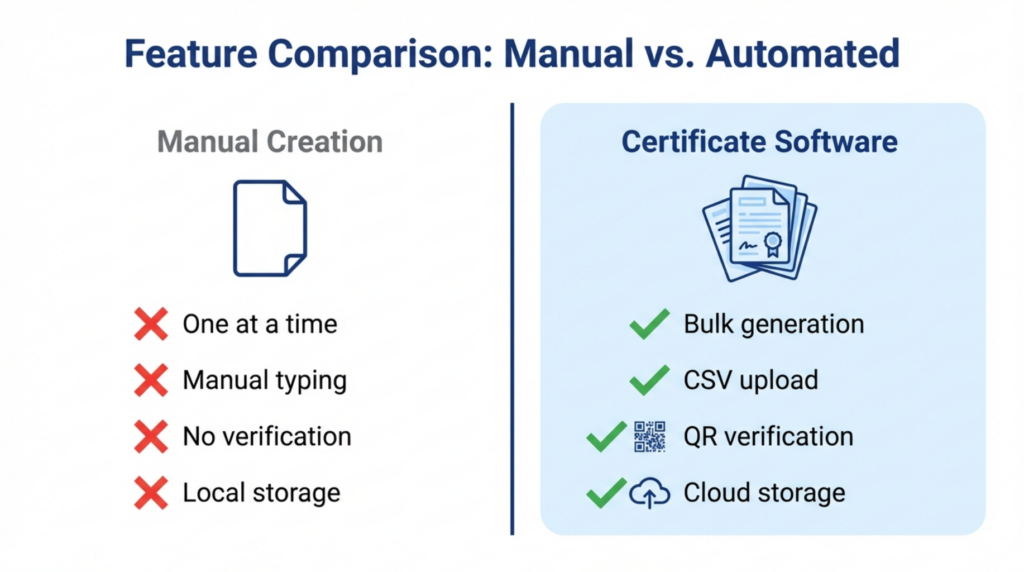
When evaluating the best certificate software for education, institutions should compare these critical features across different approaches:
| Feature | Design Tools (Canva/Word) | Manual PDFs | Certificate Software |
|---|---|---|---|
| Bulk generation | No (one at a time) | Limited (mail merge) | Yes (1,000+ in minutes) |
| Student data handling | Manual entry each time | Spreadsheet maintenance | CSV upload, automated |
| Verification | None | None | QR codes, unique IDs |
| Branding consistency | Varies by designer | Template-dependent | Automated consistency |
| Email delivery | Manual individual sends | Manual with mail merge | Automated bulk email |
| Record storage | Local files only | Local files only | Cloud-hosted permanently |
| Scalability | Poor (linear time increase) | Limited | Excellent (any volume) |
Bulk generation capability determines whether institutions can efficiently process large cohorts. The best certificate software for education handles 1,000 students as easily as 100, while manual methods scale linearly with volume.
Student data handling through CSV uploads eliminates repetitive data entry. Faculty exports student lists from learning management systems directly into certificate generation workflows.
Verification features protect institutional reputation by preventing credential fraud. Platforms like MixCertificate include verification portals where employers can confirm certificate authenticity without administrative staff involvement.
Branding consistency ensures all certificates reflect institutional standards. Software templates maintain precise formatting, colors, and logos across thousands of certificates, regardless of who processes the batch.
Email delivery automation reduces distribution time from hours to minutes. Systems send personalized emails to hundreds of students simultaneously, with each email containing their specific certificate.
Automation, Accuracy & Scale in Education
The best certificate software for education automates workflows connecting directly to exam systems.
Manual certificate issuance follows a labor-intensive path. Exam results arrive, staff members manually create certificates, supervisors review for errors, and administrators distribute to students. This process takes weeks for large cohorts.
The best certificate software for education automates workflows connecting directly to exam systems. When results finalize, administrators upload student data and generate certificates immediately. The entire process completes in hours rather than weeks, allowing faster credential distribution to students.
Error reduction represents a critical advantage. Manual creation produces errors in 1 to 3 percent of certificates due to typing mistakes. Certificate software for education validates data before generation, flagging missing information or incorrect formatting. Error rates drop below 0.1 percent.
Growing institutions particularly benefit from automation. As enrollment increases from 500 to 2,000 students, manual certificate creation becomes impractical. The best certificate software for education handles growth without proportional increases in administrative workload.
Certificate Verification & Academic Trust
Academic credentials require verification to maintain value. Employers verify degrees before hiring. Universities verify prerequisite courses before admitting transfer students. Without reliable verification, credentials lose credibility.
Fake certificates and academic fraud damage institutional reputations. Diploma mills produce fraudulent credentials that undermine legitimate institutions. Employers encountering fake certificates become skeptical of all credentials, requiring verification for every applicant.
QR codes provide instant verification through smartphone scanning. Each certificate contains a unique QR code linking to a verification portal. Employers scan the code and immediately see student name, program, completion date, and institution name.
Verification IDs offer an alternative for environments without QR scanning capability. Certificates display unique alphanumeric identifiers like EDU-2024-12345. Verifiers enter this ID on the institution’s verification portal to confirm authenticity.
Hosted certificates remain accessible permanently through verification portals. Unlike PDF files that students might lose, hosted certificates provide perpetual access via unique URLs. This supports alumni verifying credentials years after graduation.
According to Inside Higher Ed research, credential fraud remains a persistent challenge.
Use Cases in Education
Schools & Colleges
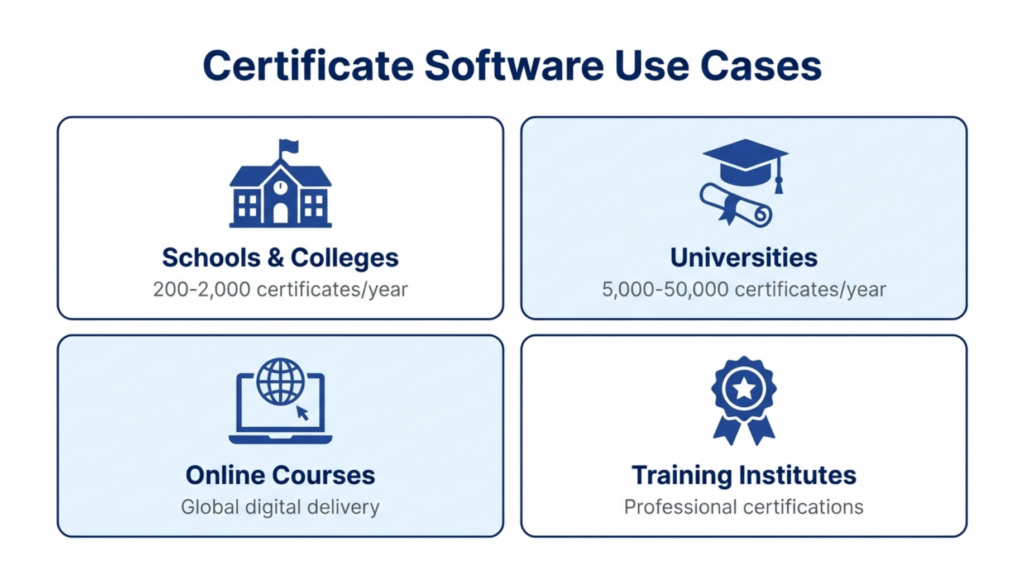
Secondary schools issue certificates for course completions, honor roll achievements, and extracurricular participation. Volume varies from 200 to 2,000 certificates annually depending on school size.
Certificate software enables schools to process entire graduating classes in single batches. Instead of creating certificates throughout the year, staff can generate all certificates during specific windows aligned with academic calendars.
Universities & Degree Programs
Universities operate at significantly larger scales, issuing 5,000 to 50,000 certificates annually across multiple programs and campuses. Degree certificates require particular attention to accuracy given their long-term importance for graduate careers.
Platforms like MixCertificate handle university-scale volumes while maintaining permanent verification records. Alumni accessing credentials 10 years after graduation find the same verification functionality available immediately after issuance.
Online Courses & MOOCs
Online education platforms issue certificates for course completions, specializations, and professional development programs. Global student bases create demand for digital credentials accessible from anywhere.
Digital certificate software supports online education by providing students immediate access through email links. No physical distribution required, enabling instant credentialing upon course completion.
Training Institutes & Skill Programs
Professional training institutes issue certificates for skill development, certification programs, and continuing education. These credentials often require verification by employers or licensing boards.
Verification features become essential for training certificates. Employers need to confirm employees completed required training. Licensing boards verify prerequisites for professional certifications.
Pros and Cons of Certificate Software for Education
Advantages:
- Dramatic time savings (hours to minutes for large batches)
- Consistent branding across all certificates
- Built-in verification preventing credential fraud
- Permanent digital records eliminating lost certificates
- Scalability supporting institutional growth
- Automated distribution reducing administrative workload
- Data validation preventing errors before issuance
Disadvantages:
- Platform costs (though often less than labor savings)
- Initial setup and template creation time
- Staff training requirements
- Less design flexibility than custom design tools
- Dependency on platform uptime and support
What to Look for in the Best Certificate Software for Education ?
Evaluation criteria should prioritize features specific to educational needs. Pricing transparency matters for budget-constrained institutions. Look for clear pricing tiers based on certificate volume rather than hidden costs or per-user fees.
Bulk capability determines whether software can handle institutional volumes. The platform should process your largest anticipated batch without performance degradation. Test with realistic data volumes during evaluation.
Verification features protect institutional credibility. QR codes and unique IDs should be standard, not optional add-ons. Verification portals must remain accessible permanently, not expire after a subscription period ends.
Student data privacy compliance ensures adherence to educational regulations. Certificate software should meet data protection standards applicable to student records in your jurisdiction.
MixCertificate represents one example of education-focused certificate software. The platform offers bulk generation, verification systems, and free tiers suitable for many institutional budgets. However, institutions should evaluate multiple options based on specific requirements.
Template flexibility allows institutions to maintain distinct branding for different programs or departments. A university might need separate templates for undergraduate degrees, graduate degrees, and continuing education certificates.
Which Certificate Software Is Right for Your Institution?
Small schools issuing under 500 certificates annually benefit from platforms with generous free tiers or affordable entry pricing. Manual methods might seem acceptable at this scale, but automation still saves 10 to 20 hours annually.
Medium institutions processing 500 to 3,000 certificates annually require reliable bulk generation and verification. Labor savings become substantial at this volume, easily justifying platform costs. Free tiers from platforms like MixCertificate often cover this range completely.
Large universities issuing 5,000 to 50,000 certificates annually need enterprise-grade reliability and scalability. Verification becomes critical given the volume of employer and graduate school verification requests. Premium platforms with dedicated support and advanced features justify their costs at this scale.
Online education providers prioritize immediate digital delivery and global accessibility. Certificate software should integrate with learning management systems to automatically trigger certificate generation upon course completion.
Frequently Asked Questions
What is the best certificate software for education?
The best certificate software for education depends on institutional volume and budget. Platforms offering bulk generation, verification features, and educational pricing work well for most schools and universities. Evaluate platforms based on your specific certificate volume and verification requirements.
Can schools automate certificate generation?
Yes, schools can automate certificate generation through dedicated software platforms. Upload student data in CSV format, select a template, and generate hundreds of certificates in minutes. Automation reduces the time from hours or days to under one hour for large batches.
How does academic certificate verification work?
Academic certificate verification uses QR codes or unique IDs embedded in each certificate. Employers or institutions scan the QR code or enter the ID on a verification portal. The system displays the authentic certificate details, confirming validity in 30 seconds without staff intervention.
Is certificate software better than PDFs for schools?
Certificate software offers significant advantages over manual PDFs for schools issuing more than 50 certificates annually. Software provides bulk generation, automated verification, and permanent record storage that PDFs cannot match. Manual PDFs work only for very small volumes under 20 annually.
How many students justify using certificate software?
Schools issuing certificates to 50 or more students annually benefit from certificate software. Time savings begin immediately, with labor reductions of 5 to 10 hours even at small volumes. At 500 students, annual time savings reach 60 to 100 hours of administrative work.
Do educational institutions need certificate verification?
Educational institutions need certificate verification to prevent fraud and support alumni career opportunities. Employers increasingly verify credentials before hiring. Without built-in verification, institutions must manually process verification requests, consuming administrative time. Automated verification eliminates this workload while protecting institutional reputation.
Can certificate software integrate with student information systems?
Many certificate platforms support integration with student information systems through CSV exports or direct API connections. Schools export student lists from their SIS and upload to certificate software, eliminating manual data entry. Advanced platforms offer direct integrations automating the entire workflow from course completion to certificate issuance.
Conclusion
The best certificate software for education transforms certificate issuance from a time-consuming manual process into an automated workflow completing in minutes. Educational institutions issuing credentials to 50 or more students annually benefit from bulk generation, verification systems, and permanent record storage.
Finding the best certificate software for education requires evaluating volume capacity, verification features, and pricing.
Evaluation should focus on volume capacity, verification features, and educational pricing. Platforms like MixCertificate offer solutions ranging from free tiers for smaller institutions to enterprise plans for large universities. The right choice depends on your specific volume, budget, and integration requirements.